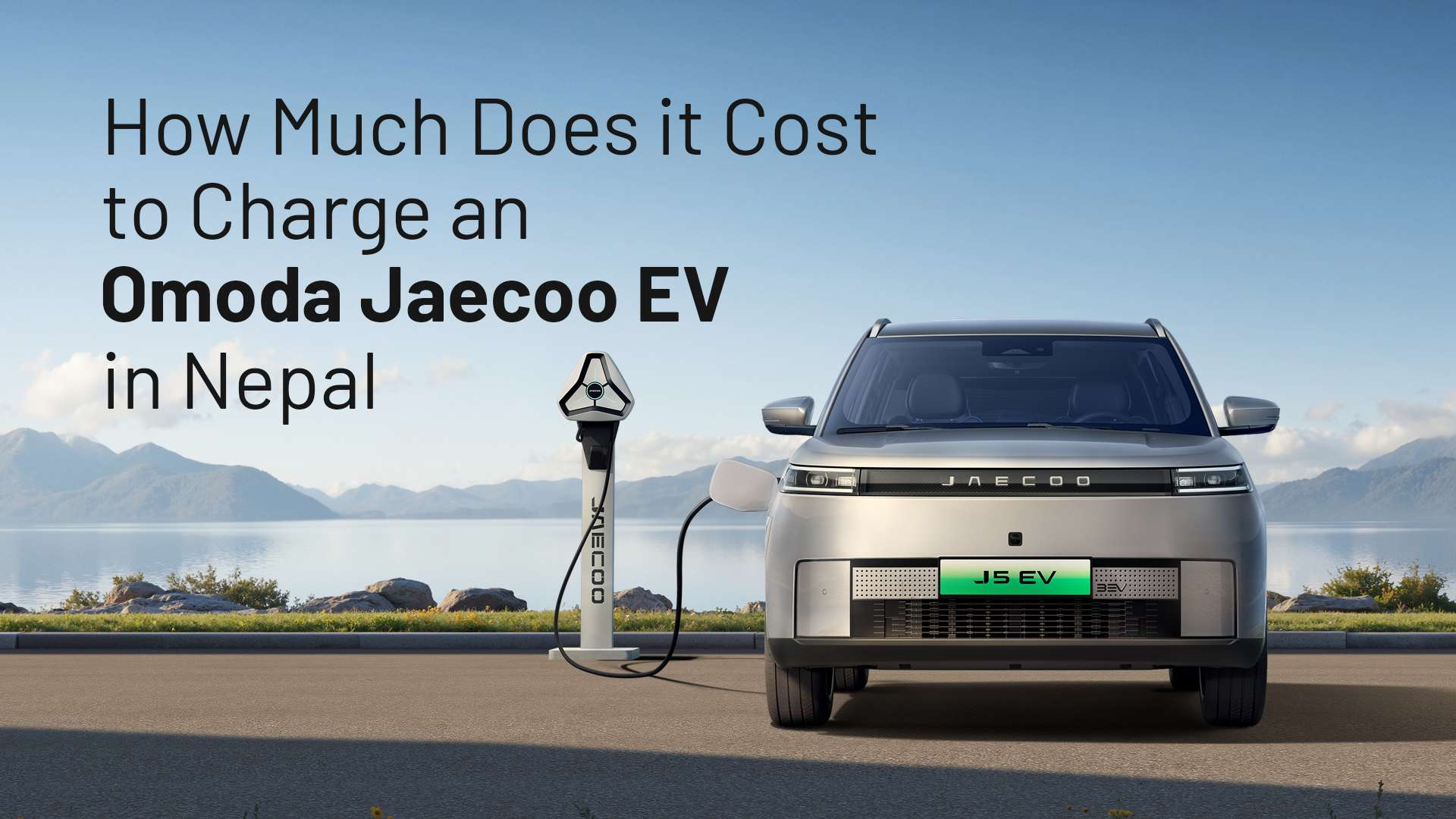
Nepal's EV Charging Network: Where You Can Charge & How to Plan a Trip?
August 12, 2026
Nepal's EV Charging Network: Where You Can Charge & How to Plan a Trip?
August 12, 2026
· The EV charging network is growing quickly in Nepal, with stations located in key cities and along the main highways.
· Public EV charging stations are becoming more common in Kathmandu, Pokhara, Chitwan, Biratnagar, Butwal, Nepalgunj, and other major cities.
· NEA Charge, NepalEVs, GadiCharge, ElectriVa, AirCharge are some of the applications that assist the driver to find the charging stations and plan their route with confidence.
· Omoda and Jaecoo EVs are compatible with most public charging stations in Nepal, as they are enabled with CCS2 and Type 2 standards.
· The home charging station is the best choice for daily driving, and fast chargers are the most feasible solution for long-distance travel by EV.
· The adoption of smart route planning and expanding charging stations is helping alleviate EV range anxiety in Nepal.
The EV market in Nepal has grown significantly in the past few years. Previously, a hurdle to getting on board with an EV, access to charging stations has become one of the best arguments for going electric.
In recent years, EV charging stations have been installed across major cities, tourist hotspots, and key highway routes in Nepal, facilitating long-distance EV journeys more conveniently than ever before.
EV drivers can now travel with a level of confidence unheard of a few years ago, thanks to fast charging stations, real-time charging apps and convenient home charging solutions.
This is a major change for Omoda and Jaecoo owners. With access to a growing charging ecosystem, modern CCS2 fast-charging compatibility, and intelligent route-planning tools, every journey.
Every day the city commutes, weekend road trips, and it's easier, more efficient, and more fun.
This guide focuses on the best EV charging stations in Nepal, the applications that facilitate easier planning, charging station costs, EV charger compatibility, and what EV drivers such as Omoda or Jaecoo should know about taking advantage of the country's expanding EV charging infrastructure.
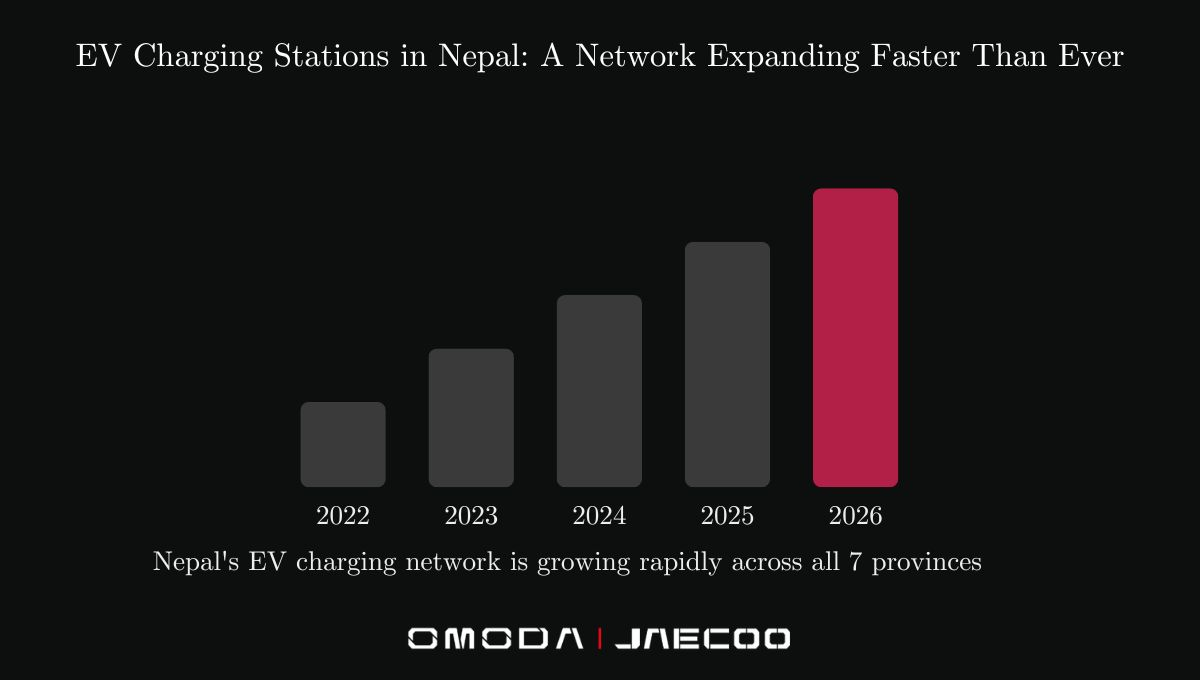
In recent years, Nepal's EV charging infrastructure has been significantly expanded.
According to the Nepal Electricity Authority (NEA), the utility currently operates 62 DC fast-charging stations across the country. Meanwhile, NepalEVs maps 335 charging sites and industry studies indicate that the ecosystem could now have more than 1,000 working charging points, counting charging stations, charging guns and private charging points.
These numbers illustrate one thing, which is that the charging network for EVs in Nepal is not restricted to Kathmandu Valley. There is a growing number of public electric vehicle charging stations throughout cities, tourist destinations, and transport hubs.
This growth is helping alleviate one of the main concerns of potential EV buyers: EV range anxiety. The more charging stations in the country, the more convenient it will be for people to use EVs for their commutes and long trips.
Considering a switch to an EV?
Speak with our team to gain more information about home charging, charging compatibility, ownership costs, and the best Omoda and Jaecoo model for you.
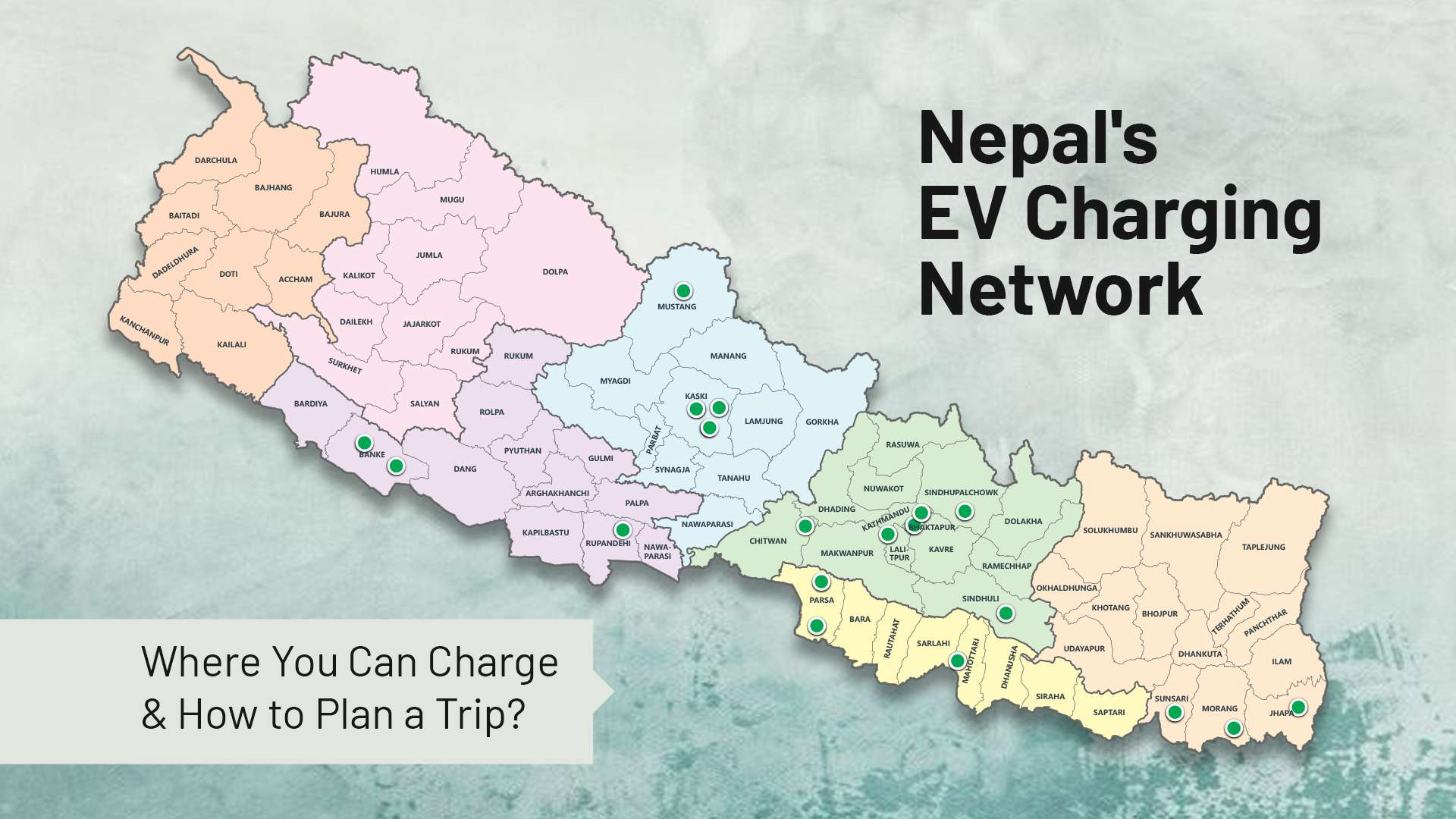
The EV ecosystem in Nepal is still centered around Kathmandu, with the most public EV charging stations here.
Omoda Jaecoo Nepal's charging network encompasses key locations in Sitapaila and Uttardhoka, and the larger network covers major cities and destinations such as:
· Pokhara
· Biratnagar
· Butwal
· Sindhuli
· Jhapa
· Sunsari
· Mahottari
· Banke
· Sindhupalchowk
· Nepalgunj
· Birgunj
· Mustang
With the number of EV charging stations increasing in Kathmandu and Pokhara city, a number of EV owners can now access charging facilities while shopping, eating or working or while staying overnight in the city.
One of the most important EV charging infrastructure developments in Nepal is the expansion of highway charging.
Omoda Jaecoo Nepal has been working to ensure charging stations are available on major highways and checkposts roughly every 60 km, assisting drivers to make informed choices on road trips beyond the city limits.
Route planning for EV travel in Nepal is easier than it was several years ago. Drivers can now find charging stations in advance and plan charging stops seamlessly.
The following are some of the popular routes that are well connected with public charging stations:
· Kathmandu–Pokhara corridor
· Kathmandu–Chitwan corridor
· East-West Highway segments
· Major tourism routes across Nepal
The premium EV ownership experience involves more than just the car. It's also critical to have reliable charging data.
To find public EV charging stations in Nepal, check their availability, and plan your trip more efficiently, several apps and platforms have been developed for drivers.
NEA's official charging platform gives you access to the charging stations and charging information in public.
Users can find and get directions to nearby charging stations, then pay for charging through the GadiCharge app.
There are currently over 50 charging stations at ElectriVa, available for both CCS2 and GB/T, ranging from 30 kW to 180 kW.
AirCharge has built one of the biggest private charging infrastructure ecosystems in Nepal with over 16 high-speed charging stations and 200+ charging guns.
NepalEVs provides an EV charging map, EV route planner, EV charger information and real-time station data.
One of these platforms can be used to check accessibility of chargers, along with compatibility of connectors, before embarking on any highway trip.
The standard of your vehicle's charging system can make a huge difference in the charging experience.
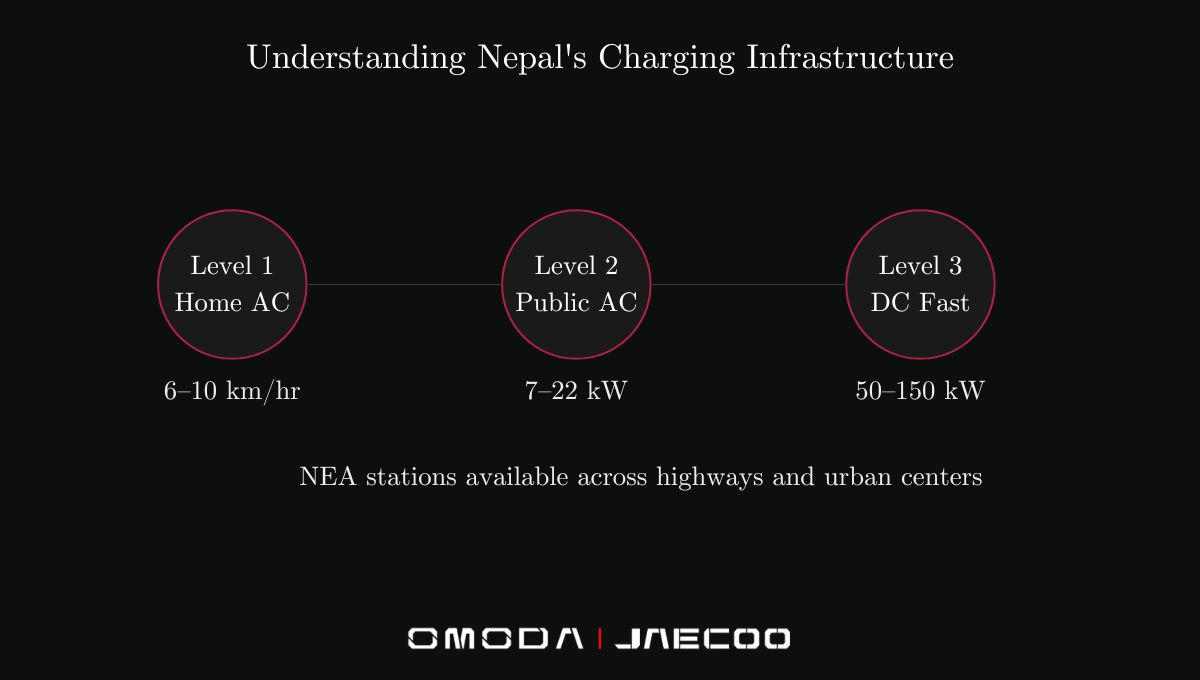
Omoda and Jaecoo vehicles offered in Nepal are compliant with global charging standards and are supported by the expanding charging infrastructure in Nepal.
|
Charger Type |
Connector |
Typical Power |
Typical Charging Time |
|
Home Socket |
Standard household socket |
Low-power charging |
Overnight charging |
|
AC Wallbox |
Type 2 |
7–22 kW |
Approximately 4–10 hours |
|
DC Fast Charger |
CCS2 |
Up to 130 kW+ |
Approximately 28–45 minutes (30%–80%) |
The Jaecoo J5 is compatible with CCS2 and Type 2 charging, enabling access to most of the latest EVs charging stations in Nepal.
The bottom line for most drivers is:
· Use Type 2 for AC charging.
· DC fast charging with CCS2.
· Check the compatibility of connectors before embarking on long distance travel.
Modern EVs in Nepal are increasingly adopting CCS2, helping make public charging more standardized and convenient.
Public charging continues to grow, but home charging is the basis of EV ownership.
Omoda and Jaecoo owners charge at home for everyday driving and at public fast charging stations for longer journeys.
All EVs have a portable charging cable included, which can be plugged into a standard household outlet.
Many drivers find that they can charge overnight without making major changes to their lifestyle to get the power they need for commuting during the day.
A dedicated Level 2 wallbox charger is recommended for greater convenience of ownership.
The charger's range between 7kW and 22kW rates and can charge most EVs in about 4-10 hours, which is great for long hours of charging overnight.
Based on our ownership guide, we estimate setup costs at home to be around NPR 20,000; however, final installation costs can vary depending on the wiring needs and the configuration of the property.
When charging an EV at home in Nepal:
· Hire an electrician (using a qualified one).
· Use a separate circuit for charging.
· Discuss electricity tariff options with NEA.
· Use manufacturer guidelines for safe charging.
Apartment owners should consider metered parking sockets or own EV charging facilities, if available.
There are many benefits to owning an EV, including reduced operating expenses.
Electricity rates depend on how much power is used and where it is charged, but home charging is far more cost effective than fueling a similar petrol or diesel car.
In general:
· Home charging is typically the least expensive form of charging.
· Public AC charging is convenient for destination charging.
· DC charging is the fastest charging but can be more expensive than home charging.
Running cost of EVs is usually much less than the running cost of conventional fuels for a similar distance of travel even if they are using public fast charging stations.
Lower charging costs are still one of the biggest drivers for many drivers to consider switching to electric mobility.
The journey to success with EV travel starts at home.
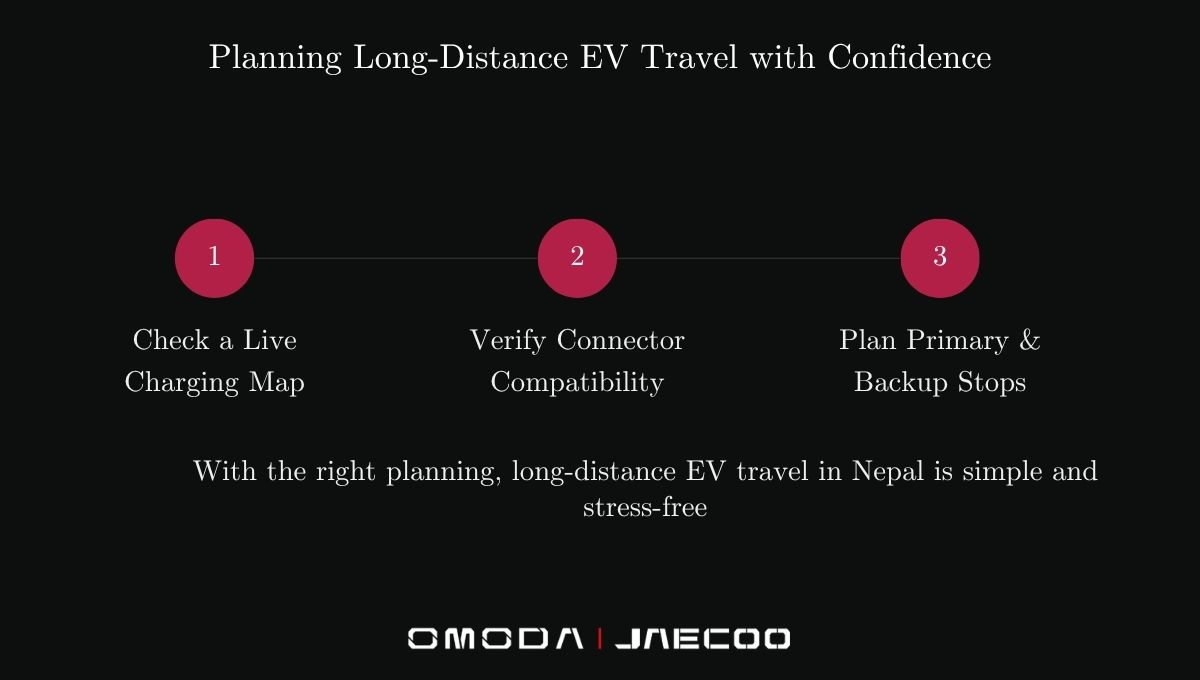
The best way to do this is to take three simple steps.
Prior to departure, check the availability of chargers with NEA Charge, NepalEVs, AirCharge, ElectriVa, and GadiCharge.
Plan your charging stop to match your vehicle's charging standard.
CCS2 compatibility ensures access to most the latest fast charging stations in Nepal for Omoda and Jaecoo owners.
Use charging stations like you would use fueling stations on a conventional road trip.
Think about where you'll charge and have a backup plan for charging.
The practice of this one habit virtually eliminates range anxiety and makes EV road trips more predictable.
Experienced EV drivers can enhance their charging routines.
Avoid these common mistakes:
· Getting on a highway without finding out if there is a charger along the way.
· Reaching a charging station having little or no battery charge remaining.
· Not checking connector compatibility.
· Using only one charging site with no backup.
· Not installing software or updates for apps.
Some preparation is essential for a more enjoyable ownership experience.
The ability of the EV and the availability of charging stations are key to modern EV ownership.
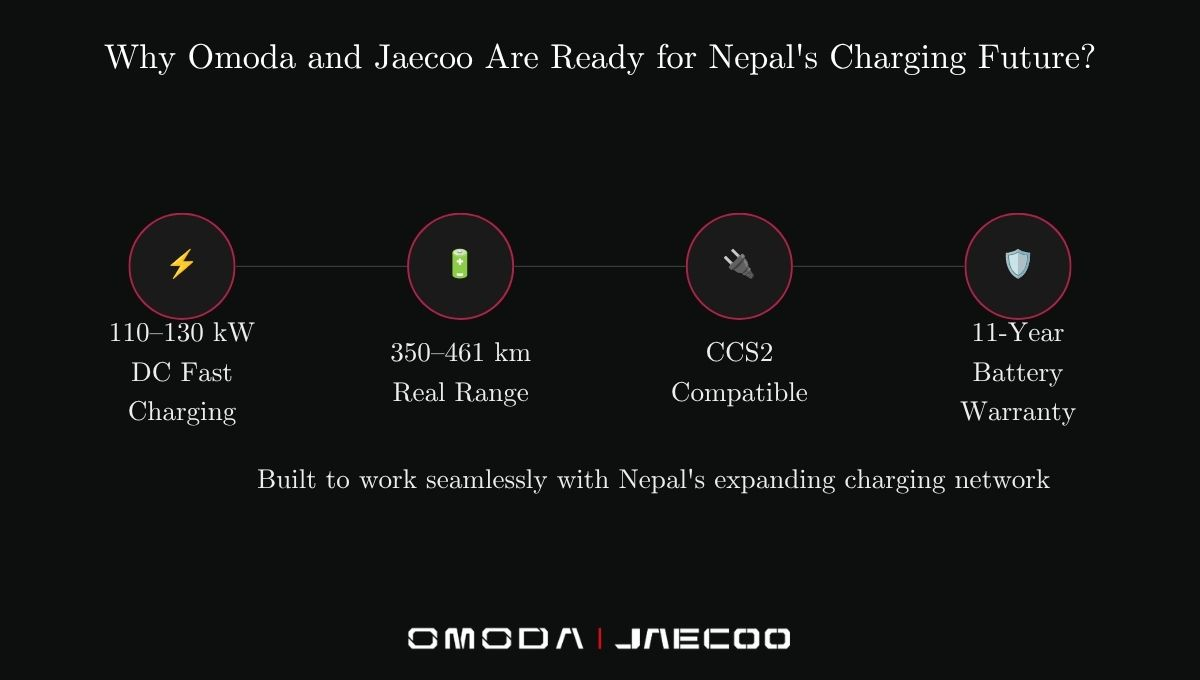
The Omoda and Jaecoo vehicles are designed to be compatible with CCS2 fast charging, are already compatible with many practical home charging solutions, and will be compatible with the growing public charging network in Nepal.
Drivers can benefit from increased convenience, flexibility, and confidence, whether they are driving around the city, commuting between major urban centers, or planning longer journeys.
Schedule a test drive today or head to your local Omoda | Jaecoo showroom to witness the future of electric mobility in Nepal.
EV charging stations in Nepal are no longer part of an emerging concept; they are becoming an integral part of the country's transportation network.
Fast chargers are being installed on more highways, urban areas are becoming more widely accessible, and digital platforms provide easier access to locating the stations for drivers and commuters.
For Omoda and Jaecoo owners, it's not just about the charging. It involves the ability to travel safely, from driving in the city traffic of Kathmandu to enjoying Pokhara's picturesque landscapes or heading further afield in Nepal.
The charging experience is even more compelling as the charging ecosystem continues to expand. With its innovative battery technology, CCS2 fast-charging capability, and user-friendly home-charging features, Omoda and Jaecoo vehicles are poised to empower drivers in Nepal to actively participate in the nation's electric mobility revolution without sacrificing convenience, performance, or peace of mind.
NEA currently has 62 fast chargers, NepalEVs shows 335 charging points and there is an estimation that there could be over 1,000 of these in Nepal as a whole.
Some of the popular ones are NEA Charge, GadiCharge, ElectriVa, AirCharge, and NepalEVs.
The most common charging standards are CCS2, Type 2, and GB/T.
Charging costs are different when charging at home, charging at AC destination chargers, and charging at DC fast chargers. For the majority of the time, EV charging is still far more affordable than using petrol or diesel power.
Yes. Most owners still prefer home charging, and for those who do, it's convenient. Most EVs can be charged at home overnight with a special home charger.
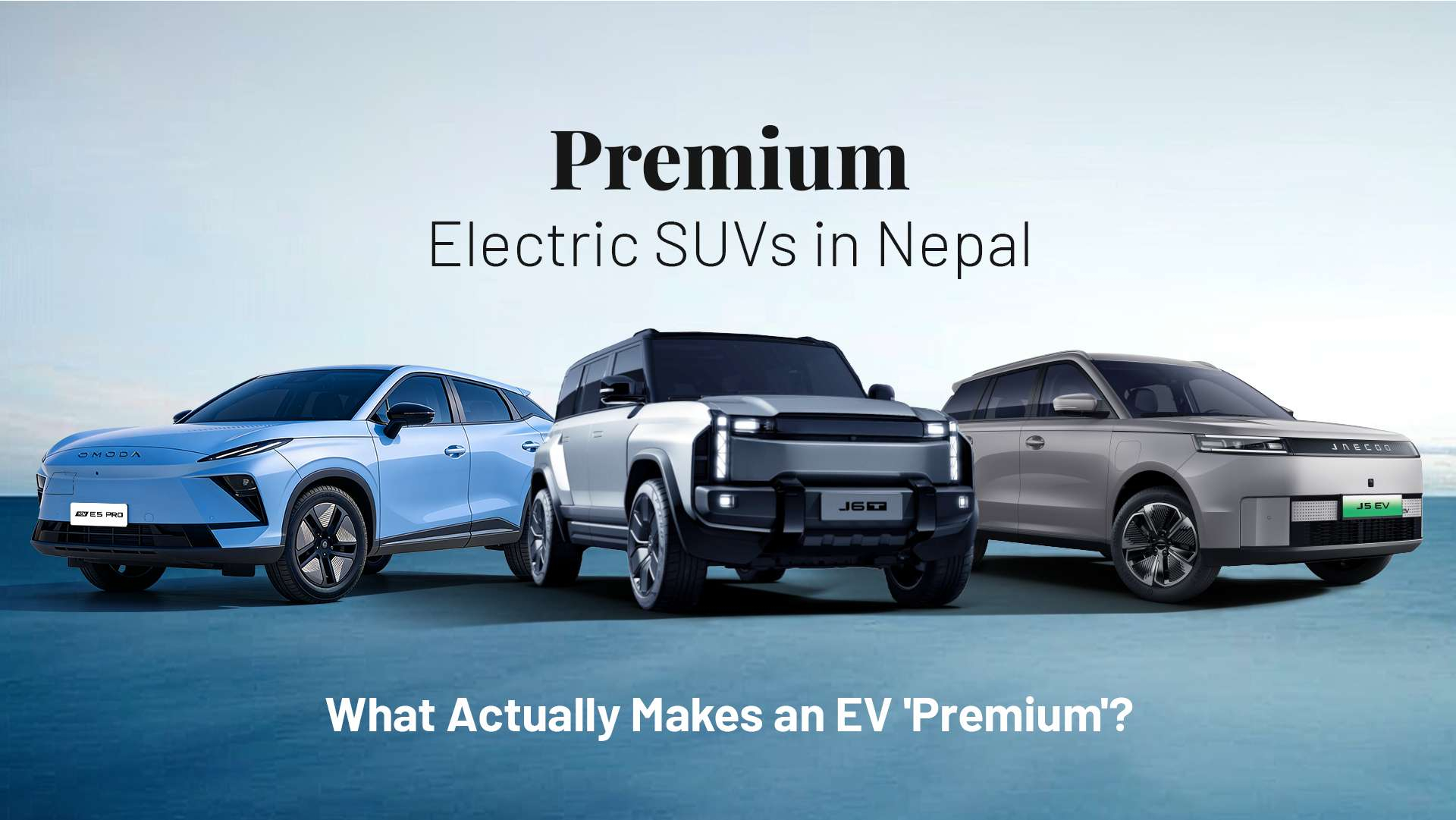
Premium Electric SUVs in Nepal: What Actually Makes an EV Premium?
August 12, 2026
Premium Electric SUVs in Nepal: What Actually Makes an EV Premium?
August 12, 2026
· A premium electric SUV offers more than just a larger battery, it combines advanced safety, intelligent technology, comfort, performance, and ownership confidence.
· In Nepal, a variety of roads requires a long driving range, quick charging speed and convenient ground clearance.
· Advanced Driver Assistance Systems (ADAS) are becoming a defining feature of the best premium electric SUVs in Nepal.
· Everyday driving comfort is enhanced by premium interior, connected technology and intelligent cockpit features.
· The EV market in Nepal is still growing at a rapid pace, driven by rising consumer demand and the growing number of charging stations.
· For modern Nepalese, Omoda & Jaecoo is a blend of high-end design, cutting-edge safety features, extended range, and user-friendly ownership experience.
In Nepal, EVs have evolved into mainstream vehicles. However, as the market expands, the question that the buyers are posing is changing. It is not simply a matter of going from fuel to electric; it is a matter of choosing a vehicle that offers more driving experience, more safety, smarter technology, and life-long value.
That's where premium electric SUVs come in
The term premium electric SUV does not just refer to the cost. The most high-quality premium EVs offer a total package of advanced safety technology, intelligent advancements, luxury comfort, reliable range and ownership confidence.
When drivers want to get an upgraded ride for their daily commute, family trips, or long-distance road trips, they need to know what truly constitutes a premium EV so they can make a smarter investment.
While battery size and pricing are still important, buyers are increasingly concerned with safety, technology, comfort, and long-term value-for-money when choosing the top premium electric SUV in Nepal.
The change is already sweeping the nation.
In recent years, EV sales have been over 70% of newly imported passenger vehicles in Nepal and it is among the fastest growing markets in the world.
The advent of widespread charging infrastructure and the ongoing progress of EV technology is making premium electric SUVs the top choice for drivers looking for a smarter, safer, and more refined driving experience.
The premium electric SUV is an electric vehicle that provides more than just transportation: it offers a range of advanced safety features, comfort, intelligent technology, performance and ownership support.
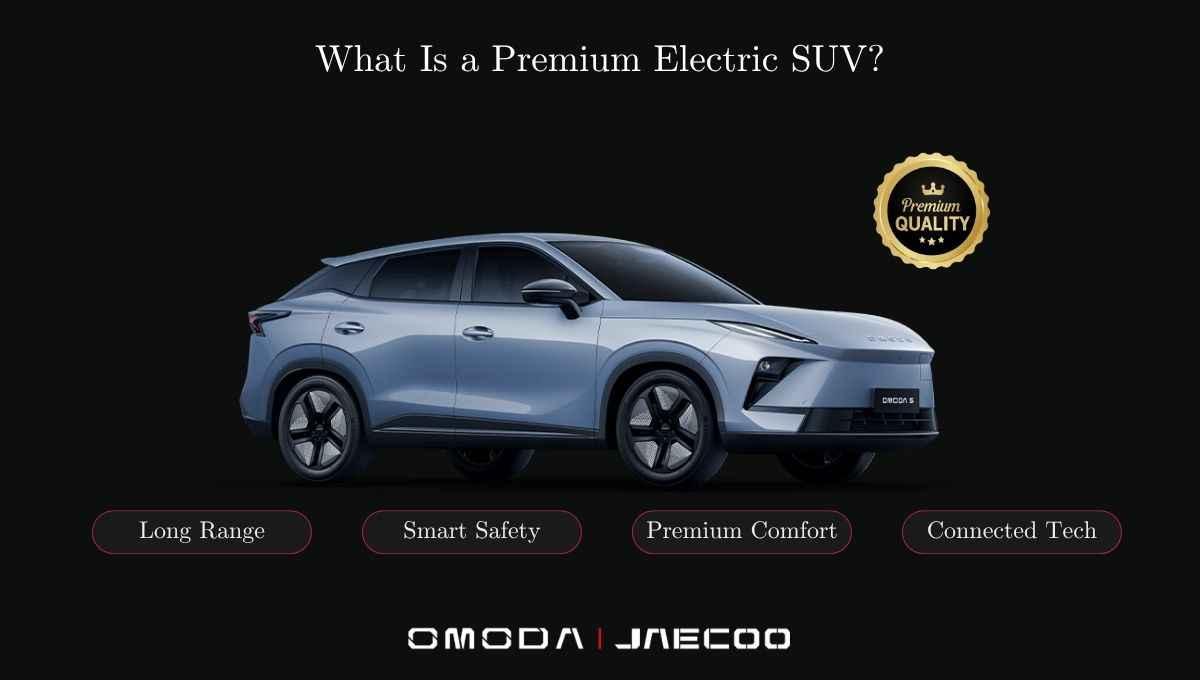
In Nepal, the premium EV needs to be functional. It must have sufficient range to handle highway driving, good ground clearance to accommodate the different terrain, rapid charging capability, and an adequate support network.
In short, a premium electric SUV should make every drive safer, more comfortable, and more enjoyable, whether you're navigating Kathmandu traffic, driving to Pokhara, or exploring beyond major cities.
Range is one of the most important factors for EV customers.
Premium electric SUVs will give you the assurance to confidently navigate your daily drive, intercity commute, and weekend excursion without worrying about running out of charge.
A good EV should be able to provide sufficient range for the following:
· Daily city driving
· Family road trips
· Business travel
· Highway driving
· Mountain routes
For instance, if you have a high range electric vehicle like a premium SUV that can go for more than 400 km, you can easily cover Kathmandu–Pokhara or Kathmandu–Chitwan on a single charge without worrying about frequent stopovers.
Long range is not only a specification, but also a convenience and owner satisfaction feature.
There are a number of clear differences between a standard EV and a premium electric SUV, including safety.
Advanced Driver Assistance Systems (ADAS) are being added to modern premium vehicles, to assist the driver in staying informed, avoiding hazards, and counteracting driver fatigue.
Some of the key technologies are:
· Adaptive Cruise Control
· Lane Keeping Assist
· Blind Spot Detection
· Forward Collision Warning
· Automatic Emergency Braking
· Rear Cross Traffic Alert
· Traffic Sign Recognition
· 360-Degree Camera Systems
The electric SUV with ADAS in Nepal has emerged as one of the most significant factors for many households as the safety features bring confidence to both city roads and highways.
These features are especially useful in Nepal's varied driving environment, which includes the possibility of rapid weather changes, road conditions, and traffic density.
A premium vehicle should have a special feel every time you get in.
Modern premium electric SUVs are designed around passenger comfort and convenience, offering features such as:
· Premium upholstery
· Ventilated front seats
· Panoramic sunroof
· Ambient lighting
· Dual-zone climate control
· Spacious seating
· Premium audio systems
· Intelligent cabin controls
This is one of the reasons why a premium family electric SUV in Nepal is an appealing choice for families who value functionality and comfort.
These elements make for a more refined way to drive and make for comfort during long journeys.
Technology is a hallmark of today's modern premium EVs.
The newest model of electric SUVs features smart dashboards with entertainment, connectivity, navigation and vehicle control capabilities all in one package.
Premium technology options can include:
· Large touchscreen displays
· Digital instrument clusters
· Wireless smartphone connectivity
· Voice controls
· Connected vehicle technology
· Over-the-air software updates
· Intelligent navigation systems
These systems engage and assist drivers and make driving easier.
The value of a premium vehicle should keep coming after buying.
This is no doubt why warranty covers, service availability, charging support, and after-sales services are significant in the premium ownership experience.
Warranties for battery life, quality, and nationwide service can be as critical as performance or design for many people buying a car.
When comparing a premium electric SUV price in Nepal, these factors should not only be considered, but they also include the warranty coverage, after-sales service, charging ease, battery protection, and running costs.
Today's Nepalese customer is now more focused on convenience with electric mobility than on fuel costs. Consumers aren't just focusing on price and battery range when choosing an EV. Rather, they want cars that provide a full ownership experience.
Modern safety, intelligent driver assistance, long range capability, quick charging, high-end interior and robust after-sales service are all what buyers are looking for today.
With charging stations growing in number throughout the country, EV charging is increasingly viable and appealing for families, professionals and business owners.
Nepal's electric mobility ecosystem is growing rapidly. The number of public charging stations has expanded greatly in recent years, and the intercity of EV ownership is becoming more feasible. With its ongoing growth, the premium EV sector is becoming more accessible and alleviating range anxiety more than ever.
This shift is helping redefine what drivers expect from a modern vehicle; and premium EVs are leading to that transformation.
OMODA & JAECOO represent a new generation of premium electric SUVs built around the needs of modern drivers.
The range benefits from intelligent technology, advanced safety equipment and high-quality interiors, and practical performance, all to satisfy the demand of buyers who expect more.
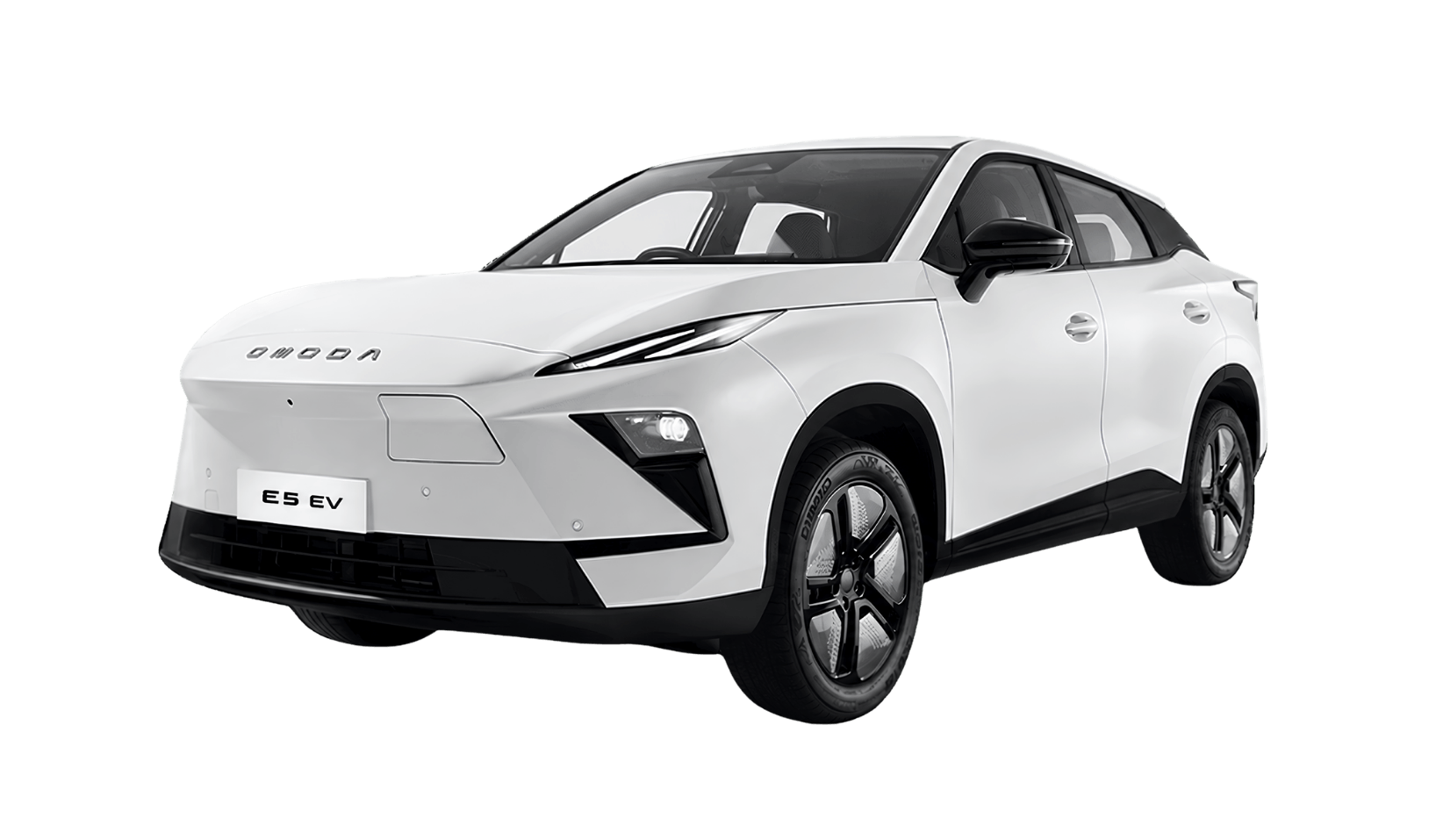
The OMODA E5 Pro is designed for drivers seeking a premium electric SUV that balances innovation, comfort, and practicality.
The E5 Pro is equipped with advanced driver assistance systems, high-tech connectivity features, luxurious interior materials and functions, and intuitive usability, making it the perfect car for city driving and family life.
High ground clearance, a modern EV design, intelligent safety features and a sophisticated cabin design combine to offer confidence on urban roads and longer trips.
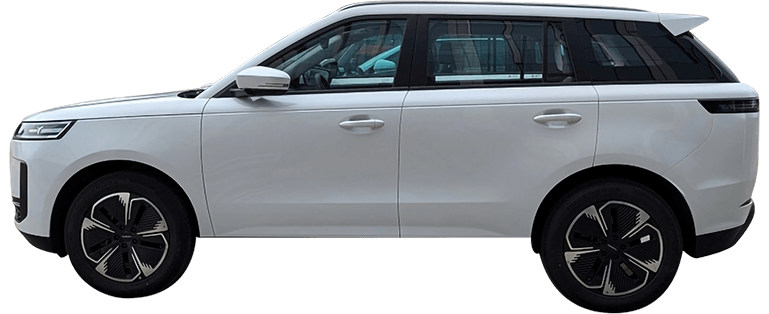
The Jaecoo J5 is designed for those who demand a more versatile and long-distance confident driver.
It features a range of advanced safety systems, intelligent driving technologies, and a roomy interior, making it a perfect balance of comfort and capability.
Whether you're commuting during the week or heading out on weekend adventures, the J5 delivers the flexibility expected from a premium SUV.
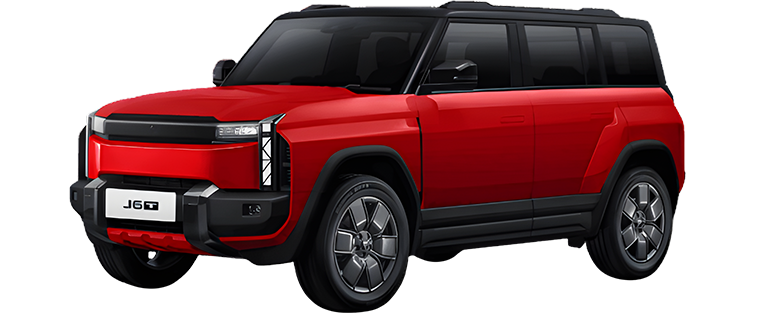
If you're looking for something more adventurous, the Jaecoo J6T brings a more rugged SUV to the table with the premium comfort.
It offers high ground clearance, cutting-edge technology and intelligent safety features alongside long-range electric performance, making it a great option for drivers who often deal with different types of roads.
The J6T is a proof of the power and sophistication of premium electric mobility.
When it comes to battery size and range, many buyers are drawn to those specs, but with high-tech safety features, it may be more important for everyday driving.
Adaptive cruise control helps to relieve fatigue on the highway. On longer trips, lane keeping assist is used to keep the vehicle in its lane. A 360-degree camera enhances visibility in overcrowded urban areas and congested parking lots.
The automatic emergency brake and blind spot monitoring give extra confidence in uncertain traffic situations, enabling drivers to make better decisions when things go differently.
These systems combine to provide a safer and more confident driving experience.
ADAS is one of the most important features in the premium electric SUV segment as more buyers are taking safety seriously. Many drivers also consider this a crucial aspect when assessing the safest electric SUV in Nepal.
The charging infrastructure is still growing in Nepal, making EV ownership a more viable option than ever before.
Fast charging features and intelligent battery management systems are a standard part of premium electric SUVs, ensuring efficiency and convenience.
Additionally, regenerative braking recaptures energy when braking, further optimizing efficiency and improving overall driving range and energy usage.
Nepal has a strong base for promoting electric mobility, as it has a growing charging infrastructure, and a lot of hydropower available. This is good news for EV owners, as they can enjoy reduced operating expenses while contributing to a more sustainable and eco-friendlier transportation future.
When combined, these technologies will make electric driving easier, smarter, more efficient, and help drivers get more out of every charge.
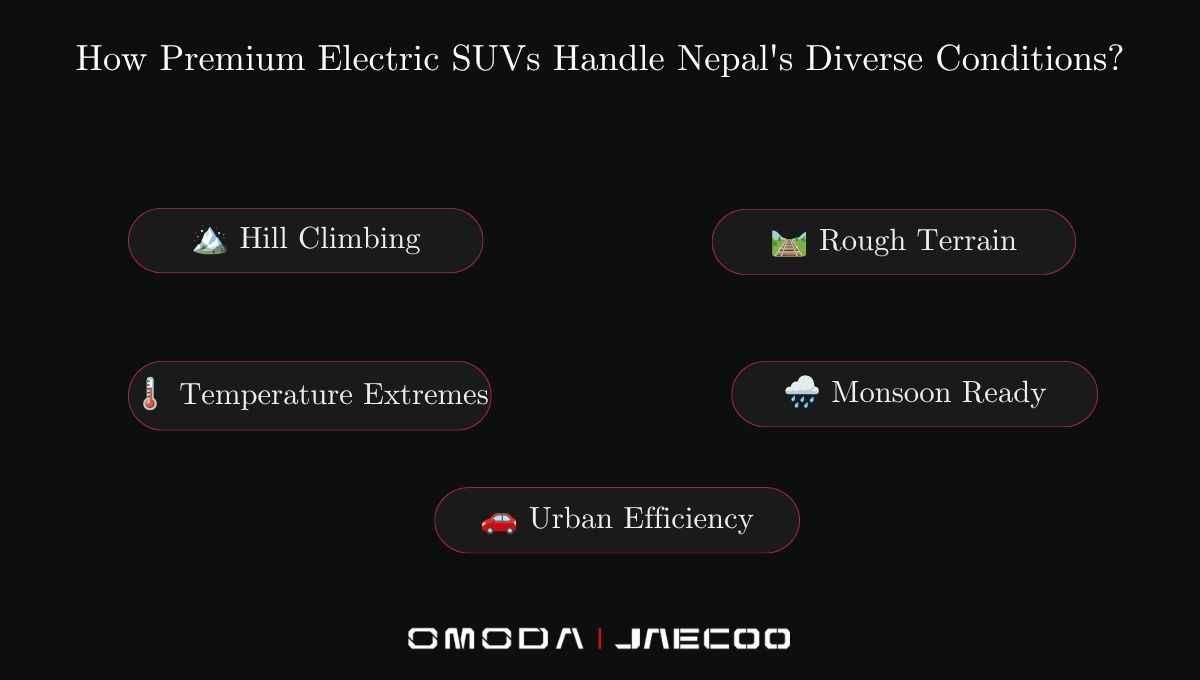
The road conditions in Nepal are challenging for automobiles.
Steep hills, bad weather, traffic, rough roads and extended highway drives are common challenges that drivers face in a single drive.
Premium electric SUVs make use of the following ways to change:
· Generous ground clearance
· Intelligent traction systems
· Advanced battery management
· Efficient regenerative braking
· Robust safety technologies
· Stable SUV-focused driving dynamics
The mix of these makes sure that you have confidence on the road in Kathmandu, Pokhara, Chitwan, Butwal, Dharan, and more.
Premium electric SUVs are ideal for:
· Professionals seeking advanced technology and comfort
· Families who value safety and functionality.
· Frequent travelers looking for long-range capability
· For first time EV buyers, looking for reassurance in ownership
· SUV owners are looking for an upgrade.
A luxury electric SUV in Nepal is more than just the battery size or the cost of the car; it's an overall ownership experience that many buyers will find more fulfilling.
The definition of premium vehicles is evolving.
Today's drivers require more than pretty design and fancy materials. They're looking for intelligent safety, connected technology, efficient performance, everyday usefulness and ownership support they know they can count on.
The premium electric SUV is the next phase of automotive innovation that merges sustainability with comfort, technology, and capability.
Experience Premium Electric Mobility with OMODA & JAECOO Nepal
A premium electric SUV is more than just a vehicle; it's a blend of cutting-edge safety, intelligent technology, unparalleled comfort, extended range capabilities, and an assurance that promises to take you anywhere.
From the best premium electric SUV in Nepal for your lifestyle to a luxury electric SUV in Nepal, OMODA & JAECOO have models for all your needs, especially premium electric SUV in Nepal.
Whether you're looking for a smart and stylish ride like the OMODA E5 Pro or a versatile all-terrain vehicle such as the Jaecoo J5 or the off-road ready Jaecoo J6T, every model promises a high-performance driving experience centered on safety, innovation, and practical use.
Ready to make the switch?
Explore our lineup, compare models, check out the latest pricing, or book a test drive to discover which OMODA or JAECOO is right for you.
Experience the future of premium electric mobility in Nepal today.
The premium electric SUV is a full package deal, featuring advanced safety features, intelligent technology, luxury comforts, extended driving range and robust ownership support.
Yes, premium electric SUVs offer a higher value to buyers who prioritize safety, technology, comfort, and ownership confidence over the long haul.
The functions of ADAS provide improvements in safety and decreased driver fatigue as well as improved driver awareness and driving comfort in both city and highway environments.
Yes. Long driving range continues to be a major concern for EV adopters, as it lowers the need for frequent charging and enhances mobility.
Buyers should look at key factors including driving range, charging capability, ADAS safety features, warranty coverage, interior comfort, technology features, ground clearance, and after-sales support.
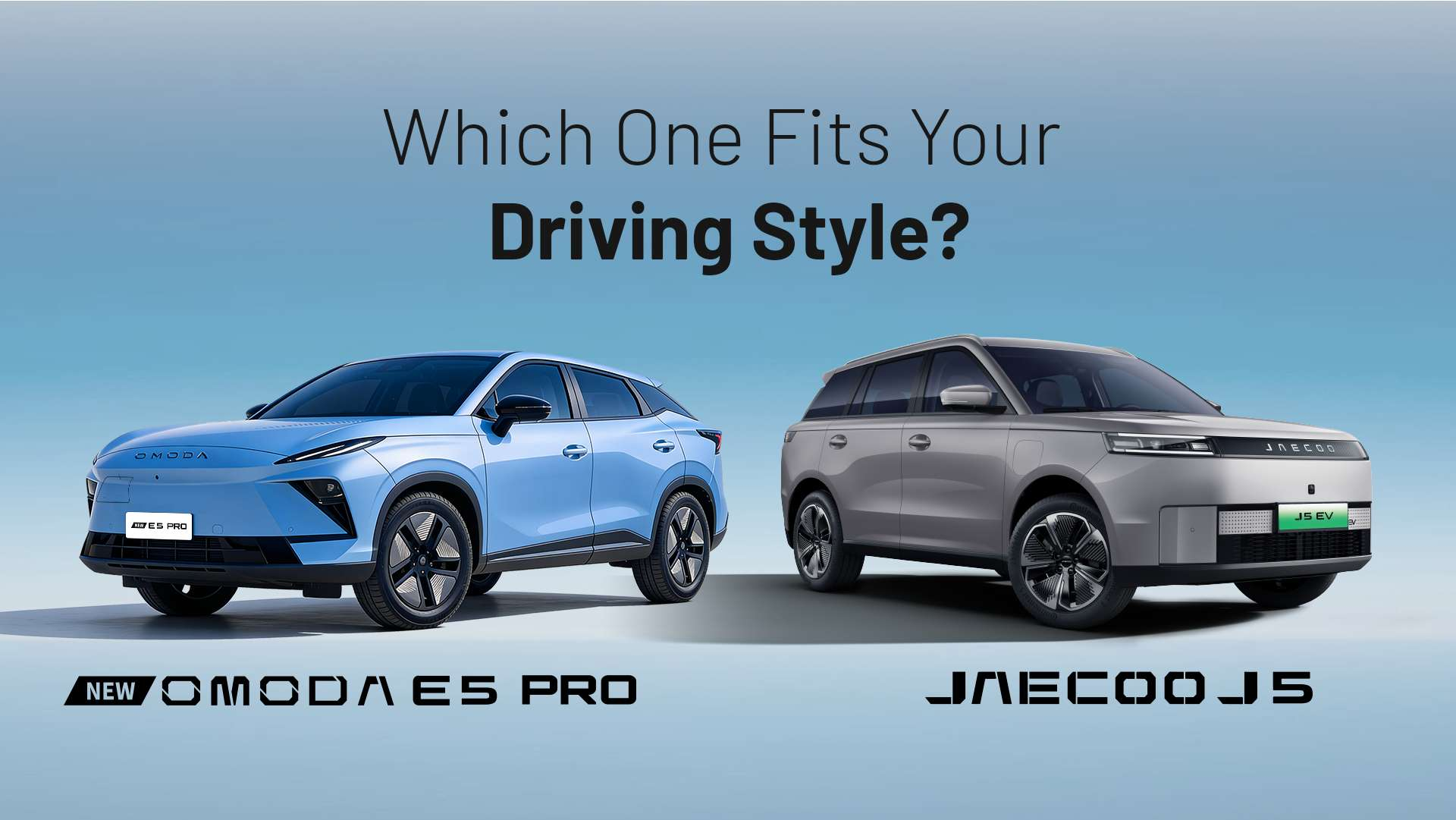
Omoda E5 Pro vs Jaecoo J5: Which Premium EV Is Right for You in Nepal?
August 12, 2026
Omoda E5 Pro vs Jaecoo J5: Which Premium EV Is Right for You in Nepal?
August 12, 2026
· Omoda E5 Pro is the most suitable option for users who prefer to purchase the vehicle with advanced technology, high-quality features, and best value for money packages priced at NPR 51.59 lakh.
· For the driver who wants more family-friendly functionality, plus more power and range (461 km), Jaecoo J5 is recommended.
· Both premium EVs are equipped with state-of-the-art ADAS safety technology, home and DC fast charging, and the industry leading 11-year extended battery and motor warranty.
· The best EV depends on your priorities; technology and affordability with the Omoda E5 Pro, or range and versatility with the Jaecoo J5.
The EV market is rapidly changing in Nepal. Today's buyers are not only interested in fuel economy, but they want to know about the technology, range, safety, comfort, usability, and ownership confidence.
The two most promising models that have come up in the high-end EV market are the Omoda E5 Pro and Jaecoo J5. Both electric SUVs share advanced safety features, high-end interiors, intelligent connectivity, and full coverage warranty coverage.
Though they both are moving forward with innovation, they are created for different lifestyles and driving priorities.
Whether you're considering buying the Omoda E5 Pro or the Jaecoo J5, this guide explains all the factors to consider including price, performance, comfort, charging, ownership benefits, and which one is right for you.
· Futuristic design and styling
· Premium technology features
· Driving comfort for advanced urban driving.
· Great value in the top tier of the EV market.
· A feature-rich first EV experience
· Longer driving range
· Stronger performance output
· More family-oriented practicality
· More confidence to enjoy longer trips.
· A high-quality everyday capable SUV
If you still need convincing, the detailed comparison below will help you determine which electric SUV best fits your lifestyle.
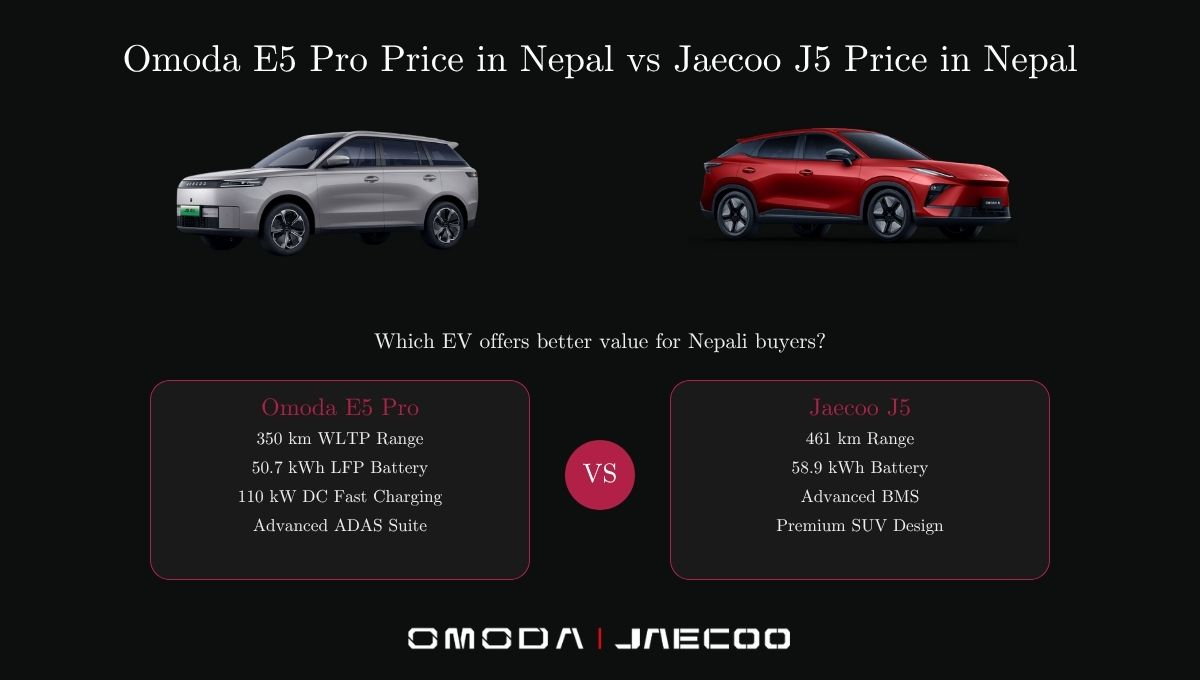
One of the initial considerations that spring to the minds of buyers when they are looking to make a purchase of a top-notch electric SUV in Nepal is the price.
The Omoda E5 Pro is priced in Nepal at NPR 51,59,000 and the dual-tone version costs NPR 51,99,000.
The Jaecoo J5 price in Nepal is NPR 56,99,000.
The Omoda E5 Pro offers a long list of high-end options and conveniences at a more affordable price.
The Jaecoo J5 is more expensive, but has a bigger battery, extended driving range, and increased power output.
Many buyers will have to choose, which is more important, maximum value or maximum range.
|
Feature |
Omoda E5 Pro |
Jaecoo J5 |
|
Price in Nepal |
NPR 51,59,000 |
NPR 56,99,000 |
|
Dual-Tone Price |
NPR 51,99,000 |
— |
|
Battery Capacity |
50.7 kWh |
58.9 kWh |
|
Battery Type |
LFP Battery |
CATL LFP Battery |
|
Range |
350 km WLTP |
461 km |
|
Motor Power |
99 kW |
155 kW |
|
Torque |
288 Nm |
288 Nm |
|
Ground Clearance |
191 mm |
185 mm |
|
Drive Type |
FWD |
FWD |
|
ADAS |
19+ Advanced Systems |
L2+ ADAS |
|
Camera |
540° Surround View |
540° Panoramic View with Underbody View |
|
Infotainment |
15.6-inch Display |
13.2-inch Display |
|
Warranty |
Up to 11 Years |
Up to 11 Years |
Best Value: Omoda E5 Pro
Best Range: Jaecoo J5
Best Performance: Jaecoo J5
Best Ground Clearance: Omoda E5 Pro
Best Family SUV: Jaecoo J5
Best Technology Experience: Omoda E5 Pro
The Omoda E5 Pro is designed for those who desire a contemporary and future-looking electric SUV.
They offer a bold design language, aerodynamic shape, and high-end styling, distinguishing them from standard SUVs. The E5 Pro makes a good first impression to the urban buyer who is looking for a stylish premium EV in Nepal.
The Omoda E5 Pro combines efficiency with everyday practicality.
Key highlights include:
· 50.7 kWh LFP Battery
· 350 km WLTP Range
· 99 kW Electric Motor
· 288 Nm Torque
· 191 mm Ground Clearance
· Front-Wheel Drive
· H-ARM Multi-Link Rear Suspension
The suspension system enhances stability and ride quality that adapts under different road conditions.
The E5 Pro stands out with features that enhance daily driving comfort.
Highlights include:
· Driver Massage Seat
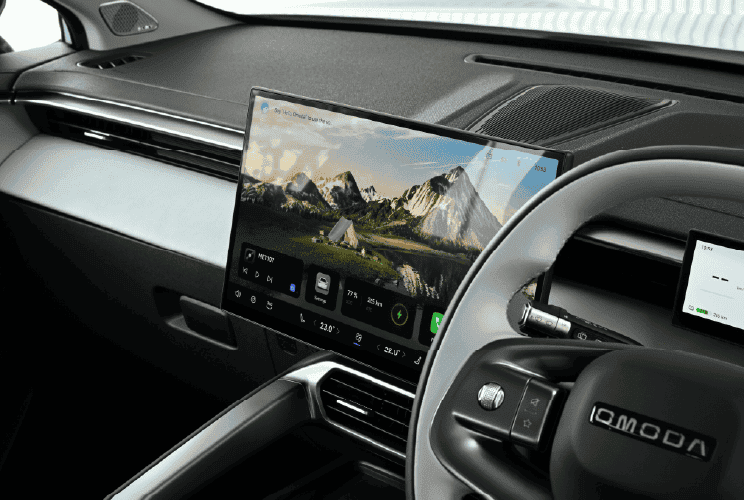
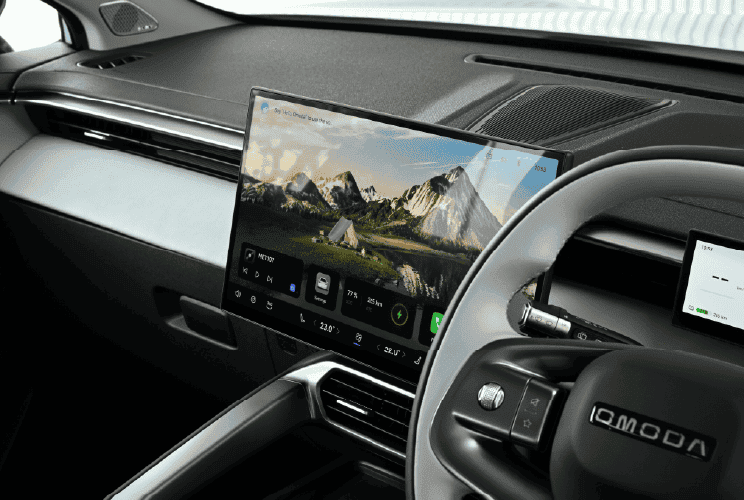
· 15.6-inch-wide display
· Pet Mode
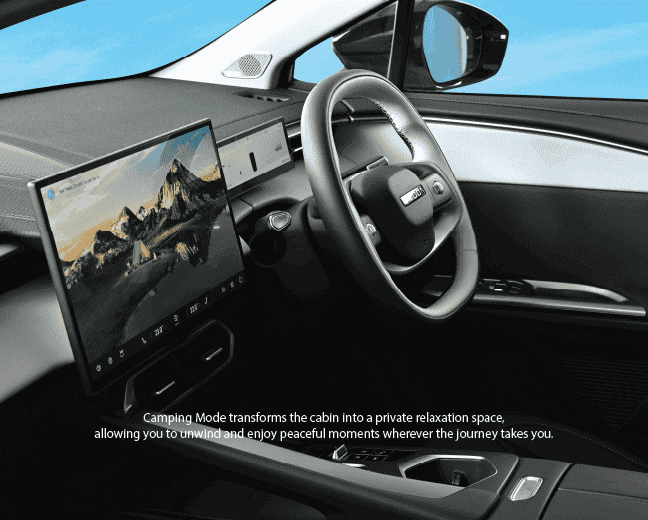
· Camping Mode
· PM0.3 Air Purification System
· 8 Sony Speakers
· 50W Wireless Charging
· Dual-Layer Front Windows
· Electric Tailgate
· Ambient Lighting
· Wireless Apple CarPlay
· Android Auto
All these are features that give a modern, connected, and refined cabin experience.
The Omoda E5 Pro comes with over 19 ADAS control functions, such as:
· Adaptive Cruise Control
· Lane Keep Assist
· Blind Spot Detection
· Forward Collision Warning
· Rear Cross Traffic Alert
· Automatic Emergency Braking
· Traffic Jam Assist
· Integrated Cruise Assist
· 540° Surround View Camera
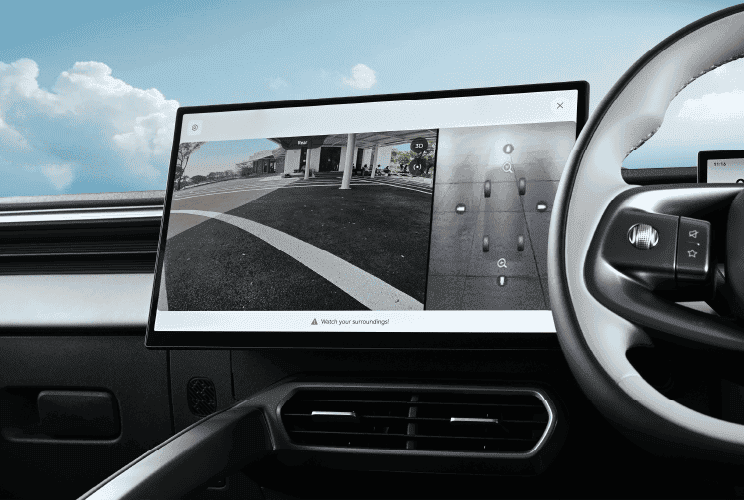
These technologies provide greater confidence and convenience for daily commuting, parking, and highway driving. e.
The Jaecoo J5 is designed to be functional, comfortable, and flexible.
The robust styling, comfortable interior, and notable off-the-road appeal make it an appealing option for families and off-road enthusiasts.
Key highlights include:
· 58.9 kWh CATL LFP Battery
· 461 km Range
· 155 kW Electric Motor
· 288 Nm Torque
· 0–100 km/h in 7.7 Seconds
The Jaecoo J5 delivers impressive capability for buyers seeking a long range EV that Nepal drivers can rely on.
The Jaecoo J5 is designed for everyday use.
Highlights include:
· 1.45㎡ Panoramic Canopy
· 480L Luggage Capacity
· Heated Front Seats
· Ventilated Front Seats
· Heated Steering Wheel
· Dual-Zone Climate Control
· Ambient Lighting
· Power Tailgate
· Wireless Apple CarPlay
· Android Auto
The features are designed to enhance the quality of the short commute and the long-distance travel experience.
The Jaecoo J5 features a number of technologies to help driver confidence.
Highlights include:
· Hill Descent Control (HDC)
· Underbody View Camera
· 540° Panoramic Camera System

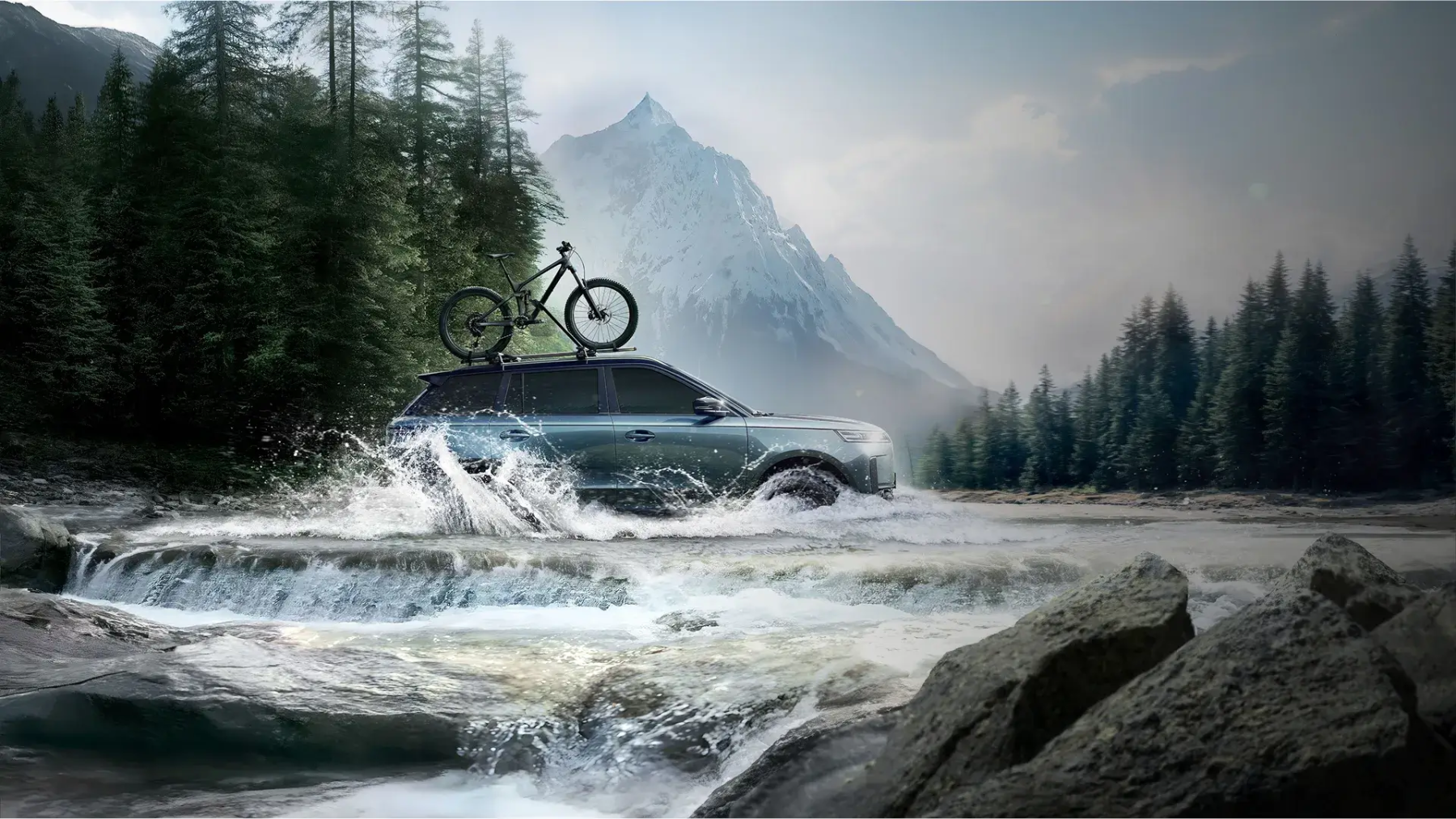
· 450 mm Wading Depth
· Independent Suspension Setup
These features enhance visibility, control, and comfort in many driving conditions.
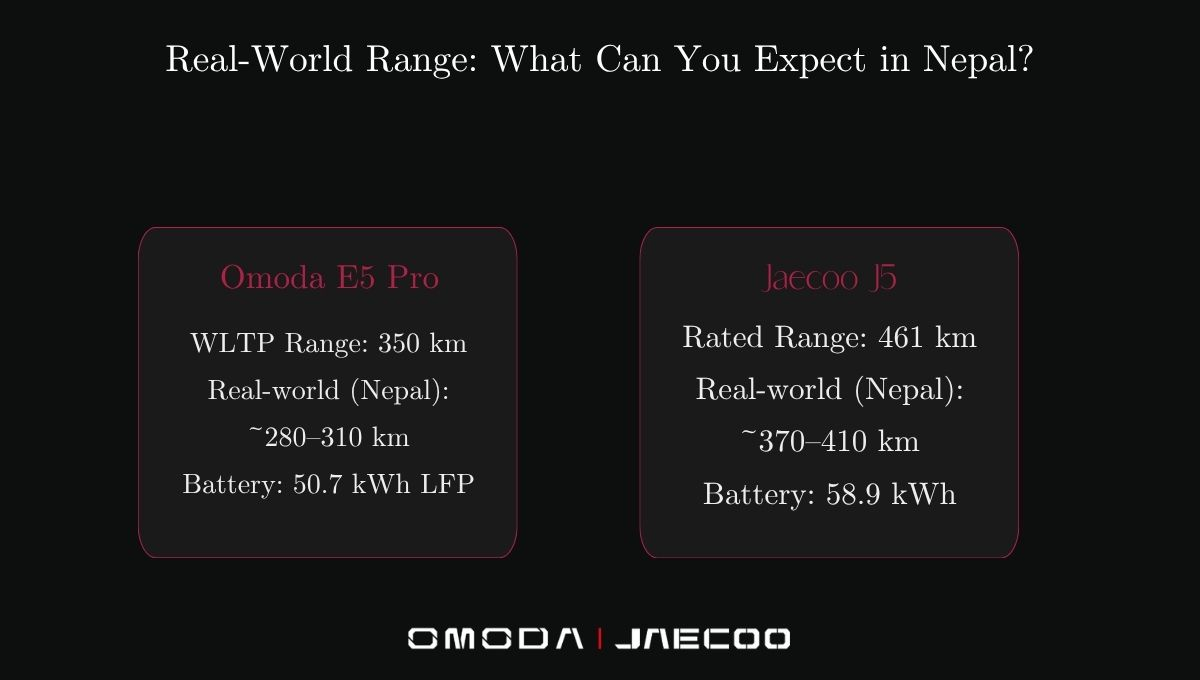
While range is a good indicator, the actual range may differ depending on road conditions, elevation changes, traffic, climate control usage and driving style.
Both the Omoda E5 Pro and Jaecoo J5 are more than adequate for everyday driving around Kathmandu Valley.
The Jaecoo J5's larger battery capacity and higher range figure offer more flexibility for longer intercity rides.
Real world EV range may be affected by:
· Road gradients and hill climbs
· Passenger and cargo load
· Air conditioning usage
· Driving speed
· Regenerative braking use
· Ambient temperature
Both cars are powered by cutting-edge LFP battery technology that ensures durability and long life.
For futuristic styling, smart technology and ultimate daily driving pleasure opt for the Omoda E5 Pro.
If you're looking for interior utility, space for your luggage, and longer-distance comfort, opt for the Jaecoo J5.
The Jaecoo J5 could be the better option, as it has a larger battery but also has a longer official range.
The Omoda E5 Pro is an appealing package of features, comfort, safety and value.
The Omoda E5 Pro's driver massage seat, Pet Mode, Camping Mode, PM0.3 air purification, and large 15.6-inch display are all standout features.
The Jaecoo J5 has the longest official range of the two models.
Both models are covered by the extended warranty programme with a view to increasing confidence in ownership over the long term.
Battery Coverage
· Up to 11 Years / 240,000 km
Motor Coverage
· Up to 11 Years / 200,000 km
This additional coverage extends to two of the critical parts of an EV and offers peace of mind.
Long-term ownership value is one of the largest motivations for more drivers to make the switch to electric mobility.
EVs have a much lower requirement for regular maintenance than petrol-powered vehicles, and they also have fewer moving parts.
There is no need for conventional oil changes and many of the common combustion-engine service parts.
Buyers should consider the following factors when assessing the cost of ownership:
· Charging costs
· Scheduled maintenance requirements
· Warranty protection
· Battery coverage
· Service support availability
As well as the longer warranty period, both models are engineered to provide confidence over their lifetime.
The number of charging stations in Nepal continues to grow and EV ownership becomes more feasible.
Home charging and fast charging are possible for both vehicles.
Benefits include:
· Home charging convenience
· Fast DC charging support
· Expanding highway charging access
· Growing nationwide charging network
· Improved confidence for long-distance travel
With the ongoing growth of the EV industry in Nepal, the ownership of premium electric SUVs becomes more attainable.
With the shift to electric vehicles, consumers are placing greater emphasis on quality, technology, and safety features, as well as long-term value.
Drivers are choosing Omoda Jaecoo for several reasons:
· Advanced CATL battery technology
· Durable LFP battery chemistry
· Premium comfort features
· Intelligent ADAS safety systems
· Extended battery and motor warranty coverage
· Growing EV support ecosystem
· Commitment to after-sales service
These benefits combine to give a superior ownership experience for modern day drivers of Nepal.
The Omoda E5 Pro and the Jaecoo J5 are two solid offers on the way to high-end electric mobility.
If you're looking for the latest technology, a futuristic design, urban comfort, and great value, the Omoda E5 Pro might be your pick.
The Jaecoo J5 combines a good range, impressive performance, adaptability, and family utility, making it a great choice for extended travel, high driving performance, and family convenience.
It's ultimately up to you and your driving style, lifestyle, and priorities.
Specifications convey part of the story. When you drive each car, you'll see how different they are.
Experience the Omoda E5 Pro's future technology. Experience the extended-range confidence and convenience of Jaecoo J5. Check out the interiors, try the features, and choose your model.
Book a test drive today! Visit Omoda Jaecoo Nepal and experience both premium electric SUVs for yourself. Whether you're searching for a technology-focused urban EV or a long-range family electric SUV, your next journey starts here.
Drive Omoda Jaecoo Nepal and taste the top-class electric SUVs. From searching for an EV with tech features to a family electric SUV, find the EV that is right for you.
The Omoda E5 Pro is priced at NPR 51,59,000, whereas the dual tone version is priced at NPR 51,99,000.
The Jaecoo J5 is available at NPR 56,99,000.
The official range of the Jaecoo J5 is 461 km and the Omoda E5 Pro has a WLTP range of 350 km.
The Jaecoo J5's larger luggage capacity, extended range and comfort-focused interior could make it better for families.
Yes. Both models are eligible for extended motor and battery warranties, as applicable in accordance with the terms and conditions.
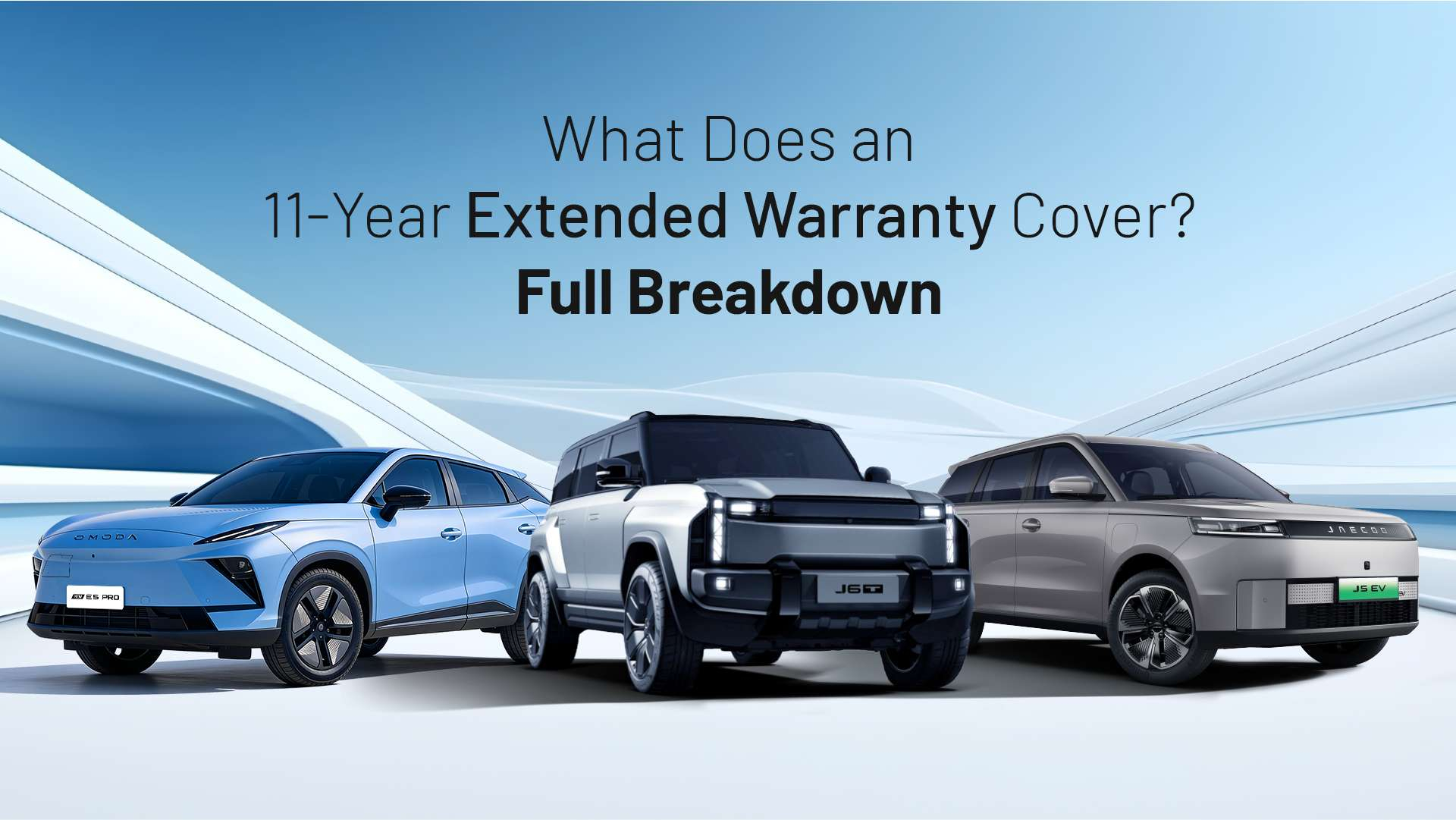
What Does an 11-Year Extended Warranty Cover? Full Breakdown?
August 12, 2026
What Does an 11-Year Extended Warranty Cover? Full Breakdown?
August 12, 2026
· 11-year battery and motor warranty (including an additional warranty period).
· It primarily applies to battery components and motor components that are eligible for warranty, and for manufacturing or quality defects.
· Does not protect against accidents, collision damage, wear and tear items, unauthorized repairs, misuse or odometer concerns.
· Authorized servicing, use of genuine/approved parts and records, and ongoing insurance with Himalayan Everest Insurance Ltd. are required for warranty validity.
· Inspection and approval are required prior to repair through an authorized OMODA | JAECOO service center.
One of the most frequently asked questions when purchasing an electric vehicle is:
What happens if something goes wrong in years after buying your EV?
That's one of the reasons extended warranties are important. An extended warranty extends protection beyond the original warranty, provided under a manufacturer's warranty.
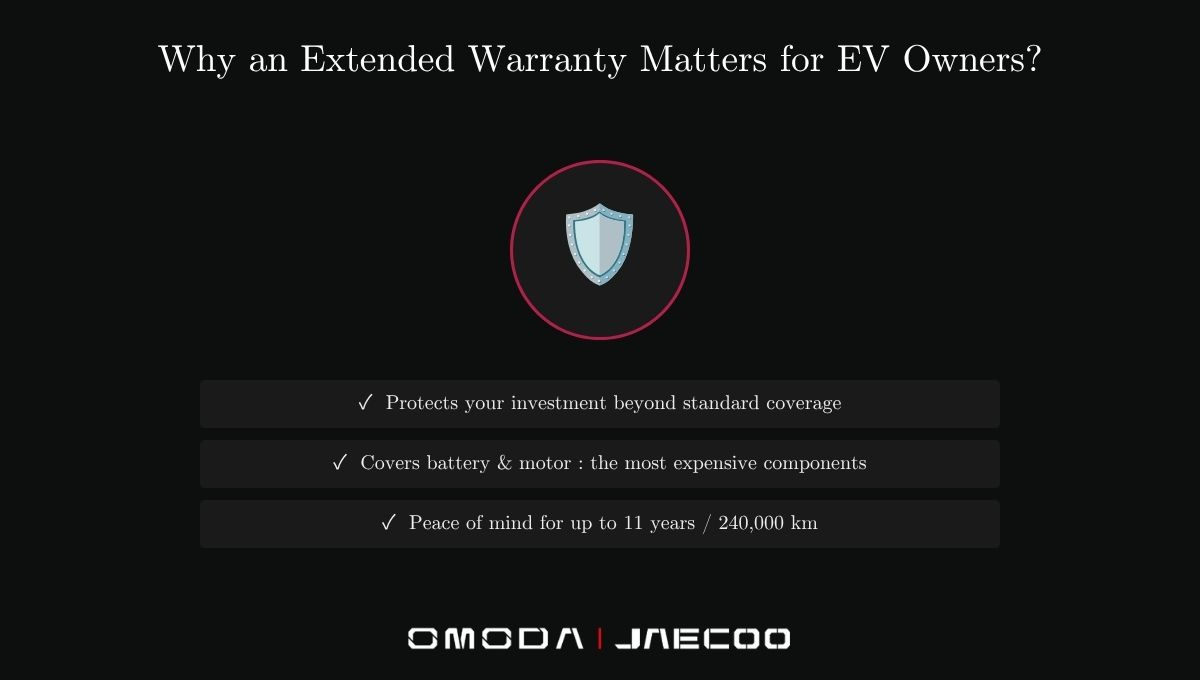
EV warranty coverage is especially vital for EV owners as the battery and motor are among the most significant and costly parts of the vehicle. Understanding the scope of an EV warranty can significantly assist EV owners in understanding their long-term ownership expectations and protection. These systems are essential in terms of performance, reliability, and ownership.
Our 11-year extended warranty is an insurance-based warranty that will be applied to eligible battery and motor parts after the manufacturer's warranty has expired.
This guide will tell you what this 11-year extended warranty covers, what it excludes, how it works and steps you must take to ensure coverage will be active.
Extended warranty is a warranty that is offered to cover a longer period of time after the expiration of the manufacturer's warranty. The manufacturer's warranty extends coverage on certain parts for a specific period and mileage, while the extended warranty provides coverage on the eligible parts based on the terms and conditions of the program.
The battery and motor are one of the most critical parts of an electric vehicle drivetrain, and knowing the warranty coverage is particularly important for EV owners.
For this reason, many buyers who are looking into buying an electric vehicle warranty want to ask three specific questions:
· Which components will be included?
· What factors are not included?
· What are the rules for maintaining coverage?
This information can be useful in making decisions about EV ownership costs, long-term battery protection, and vehicle warranty coverage.
It's also crucial to realize that an extended warranty isn't insurance. An insurance policy is used to safeguard risks like damage from external elements and accidents, while an extended warranty takes care of eligible manufacturing and quality defects of the covered components.
Understanding the difference between a manufacturer's warranty, extended warranty, and insurance helps the owner of the car understand the coverage of protection through the ownership experience.
All eligible OMODA | JAECOO EVs are covered by the original manufacturer's warranty.
Then, SPG Automobiles Pvt. Ltd. provides that protection further by offering an extended warranty program under insurance.
The overall coverage is:
|
Component |
Original Warranty |
Extended Warranty |
Total Coverage |
|
Battery |
8 Years / 180,000 km |
+3 Years / 60,000 km |
11 Years / 240,000 km |
|
Motor |
8 Years / 160,000 km |
+3 Years / 60,000 km |
11 Years / 200,000 km |
This provides eligible owners with EV warranty coverage for certain drivetrain parts, if applicable, based on EV warranty program terms and eligibility requirements.
The extended warranty covers the manufacturing and quality defects in major high voltage EV components.
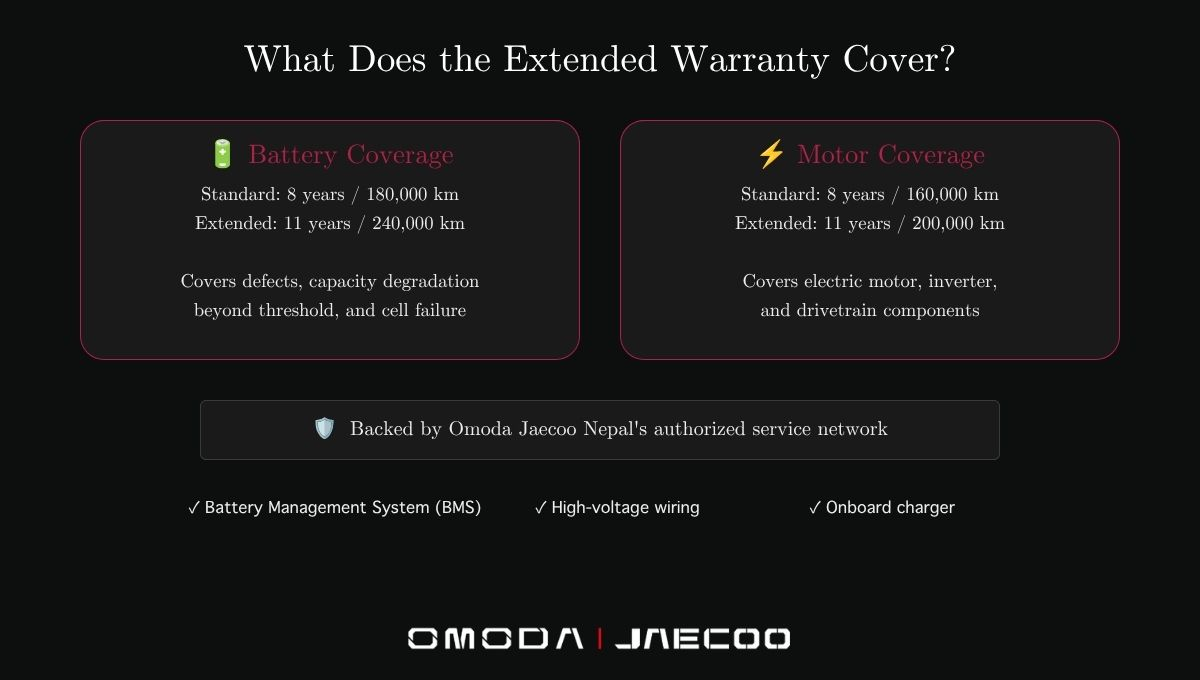
The components may differ for covered models and are subject to the terms and requirements of the program.
Many EV customers care about battery and motor system protection over the long run. The extended warranty is targeted at components, specifically battery and motor components, since they are the key components of the electric vehicle's drivetrain, as opposed to general wear and tear parts.
Among all the systems of an electric vehicle, the battery pack is one of the most crucial. It is the priciest part of most EVs, so the protection that comes from an EV battery warranty is one of the most crucial elements for a buyer to consider when deciding on a purchase.
OMODA and JAECOO vehicle coverage includes:
· High-voltage battery eligible components
· Battery-pack-related eligible parts
· Eligible battery safety and control components (as applicable).
When people are considering how they want to use the battery, battery protection is one of the first aspects they look at when considering long-term ownership.
The battery is one of the most critical components of an EV, making battery warranty coverage a major consideration for buyers. Many EV owners researching long-term ownership costs also pay close attention to potential EV battery replacement costs and the battery protection available beyond the original manufacturer's warranty.
Our extended warranty is designed to draw attention to some of the battery-related components that are eligible for coverage under the extended warranty program, and to educate owners about coverage that is available after the original manufacturer warranty term expires.
The electric motor is one of the most important parts that is covered by the program and that powers the vehicle.
Coverage includes:
· Traction Motor Assembly
· Motor Control Unit (as applicable)
The electric battery and motor together make up the electric drivetrain. The program will help clarify long-term vehicle warranty coverage, and ownership expectations by extending the protection for these eligible components.
The extended warranty does not cover accidents, collision damage, unauthorized repairs, or normal wear and tear.
Extended warranty is intended to cover the replacement of certain components for manufacturing or quality-related defects. It is not an overall repair program for all problems that could arise in owning a vehicle.
The following are excluded:
The warranty does not cover:
· Accidents
· Collision damage
· Water ingress due to external causes
· Damage caused by causes outside of the manufacturing process
Normal wear and tear, consumables are not included in the list, such as:
· Tires
· Brake pads
· Wiper blades
· 12V battery
· Similar consumable components
These may exclude coverage:
· Unauthorized modifications
· Tampering
· Non-approved parts
· Repairs at unauthorized workshops
The warranty does not apply to damage caused by:
· Misuse
· Negligence
· Racing
· Competitive driving
The coverage is denied for the following situations:
· Odometer manipulation
· Inaccurate mileage records
To keep the warranty valid, you must follow these steps:
All the servicing and repair work must be done at authorized OMODA | JAECOO service centers.
Vehicles should be kept up to the manufacturer's recommended service schedule and owner's manual specifications.
Use of genuine or approved parts is only permitted during the ownership period.
Owners are required to retain all necessary records, service history, and compliance documents.
A valid warranty requires continuous insurance coverage with Himalayan Everest Insurance Ltd.
The insurance system is as follows:
· Himalayan Everest Insurance Ltd. is the company that arranges the year 1 insurance for SPG Automobiles Pvt. Ltd.
· The subsequent years will need to be insured on an annual basis with Himalayan Everest Insurance Ltd.
· Changing insurance will terminate the extended warranty.
The extended warranty is not offered as a stand-alone policy.
The warranty is tied to the necessary insurance coverage while the vehicle is in use.
Eligibility may still exist for existing customers via the relevant premiums and inspection process with the insurance requirements being satisfied.
If the vehicle is insured outside, the extended warranty may be granted on renewal with Himalayan Everest Insurance Ltd when you insure eligible model-year vehicles from 2024, subject to certain conditions and conditions apply to the additional premium.
The insurance policy and extended warranty policy must be in effect throughout the entire warranty period.
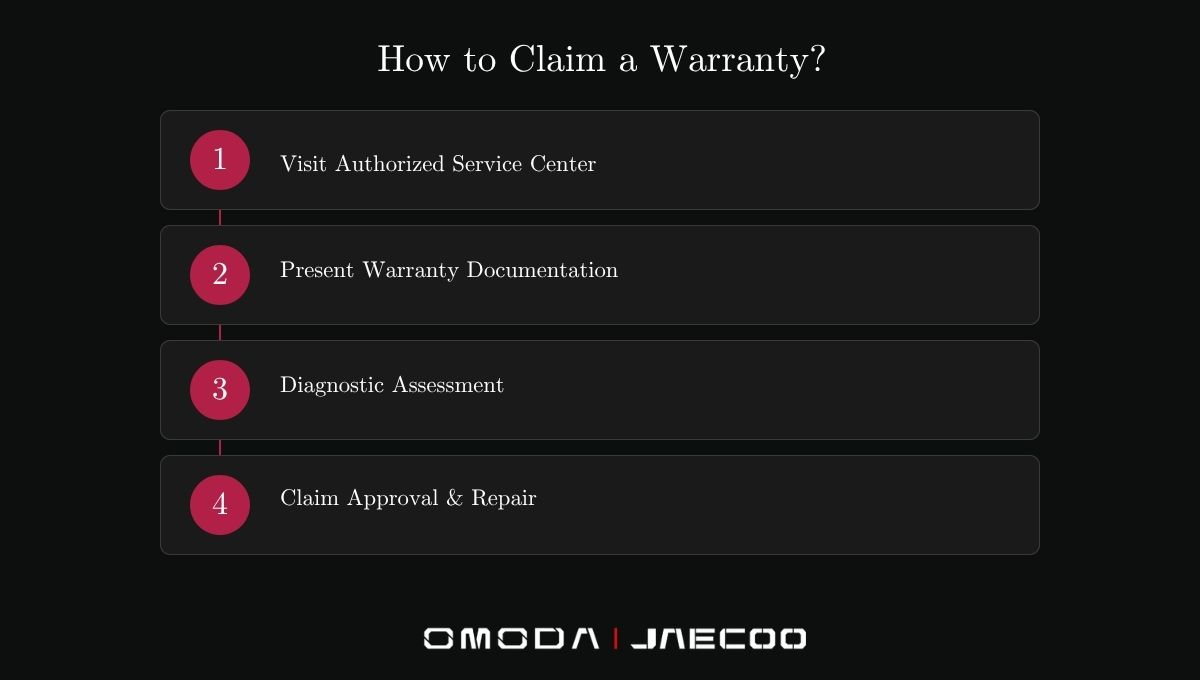
The warranty claims process for covered components is simple and starts at an authorized OMODA | JAECOO service center.
1. Visit our authorized OMODA | JAECOO service center.
2. Our service team will test the car.
3. The issue will be reviewed to see if it is a manufacturing or quality defect to be covered by the warranty program.
4. Once approved, the repair will be processed based on the terms and required documents of the program.
If repairs are required, make sure to avoid unauthorized workshops prior to the inspection. Warranty coverage may be impacted by unauthorized repairs, modifications, or replacement parts.
Eligibility and terms of the extended warranty program still apply to existing OMODA | JAECOO owners who wish to participate in the program but have not yet purchased the premium.
To qualify:
· Himalayan Everest Insurance Ltd. or transfer of insurance, to be continued at renewal.
· The car must meet the standard for eligibility inspection.
· Requirements for the program must be met.
Please call our team at 980-1143672 to help determine eligibility.
Understanding your extended warranty is just as important as choosing the right electric vehicle. Before purchasing an electric vehicle, it's important to understand your warranty coverage, exclusions, eligibility requirements, and the claims process.
Understanding the battery and motor components that are covered, what is excluded, and what steps need to be taken as an EV owner can help make ownership easier to understand.
Our extended 11-year warranty offers extra coverage for certain parts of your battery and motor beyond the manufacturer's warranty period and has built-in provisions for authorized servicing, approved parts, documentation and ongoing insurance coverage.
To learn more about your eligibility, warranty coverage, or the enrollment process, visit your nearest authorized OMODA | JAECOO showroom or service center, or contact our team for personalized assistance.
The extended warranty service covers the following warranted items:
· Eligible battery components
· Battery safety and control related components
· Traction motor assembly and motor control unit (as applicable)
under the terms of the warranty for eligible manufacturing and quality defects.
No. The extended warranty is tied to the insurance policy and is not available as a standalone policy.
The extended warranty will become invalid if you change your insurance provider from Himalayan Everest Insurance Ltd.
Take the vehicle to an authorized OMODA | JAECOO service center where it will receive inspection and processing under program terms and documentation requirements.
Yes. Existing owners may be eligible, depending upon insurance, inspection, and program requirements.
Yes. The extended warranty covers high voltage battery components and battery safety and control related battery components (as defined by program terms and eligibility requirements).
Yes. Eligible motor coverage includes Traction Motor Assembly and Motor Control Unit (if applicable).
The extended warranty is for eligible manufacturing and quality defects in specific components, whereas insurance is for risks like accident and external damage.
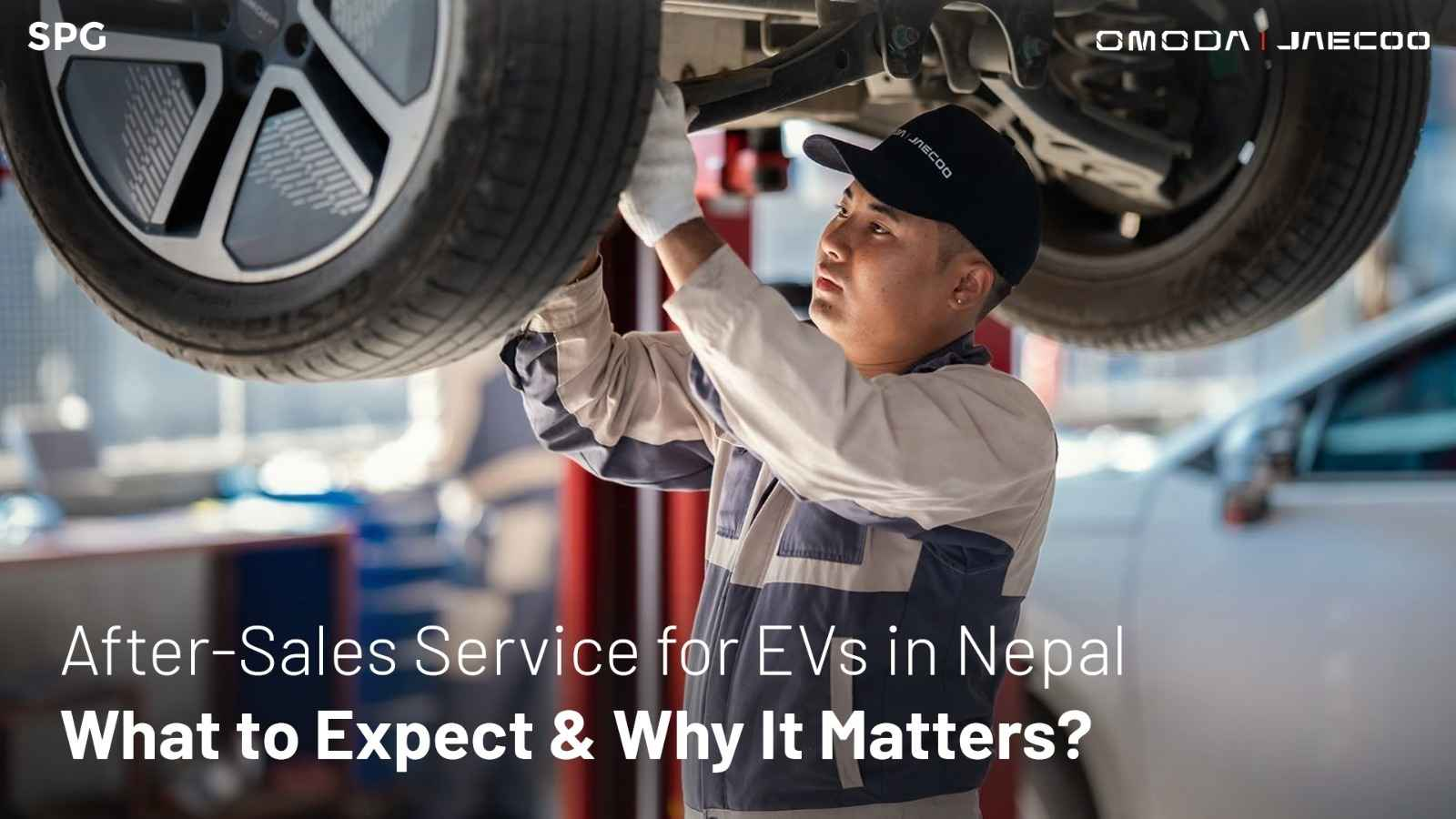
After-Sales Service for EVs in Nepal: What to Expect & Why It Matters
August 12, 2026
After-Sales Service for EVs in Nepal: What to Expect & Why It Matters
August 12, 2026
· After sales service for EVs in Nepal is crucial due to its challenging terrain, climate conditions, and the time spent traveling between cities.
· Specialized EV maintenance is required, such as battery diagnostics, software updates, correct parts, and qualified technicians.
· Support in the form of authorized service and warranty creates trust for EV buyers in Kathmandu and beyond.
· After-sales include charging support, such as highway charging, fast charging, and home charging, which enhances the convenience of EV use.
When purchasing an EV in Nepal, the decision of which to buy is more than just a matter of range, design, or cost. The actual ownership experience starts after the delivery!
After-sales services are just as crucial in a nation where road infrastructure, monsoon climate, steep uphill scenery and long-distance travel are a way of life.
This makes EV after-sales service in Nepal crucial and much needed because it not only ensures safety but also minimizes downtime and maximizes the lifespan of the vehicle.
Electric Vehicles are not like fuel vehicles.
They use a range of high-voltage systems, battery management, software, sensors, and electronic controls which require correct tools and trained technicians.
While a general workshop might be able to perform simple mechanical repairs, EVs require more specialized maintenance, particularly in the areas of battery diagnostics, software updates, and warranty-related repairs.
This is even more significant in Nepal, where ownership is not always within a single city. One can go to Pokhara, Butwal, Biratnagar, Chitwan or even further from Kathmandu.
Without the brand being able to travel that distance, it's a very quick frustration to get into. Good after-sales service is essential to make an EV a good long-term companion.
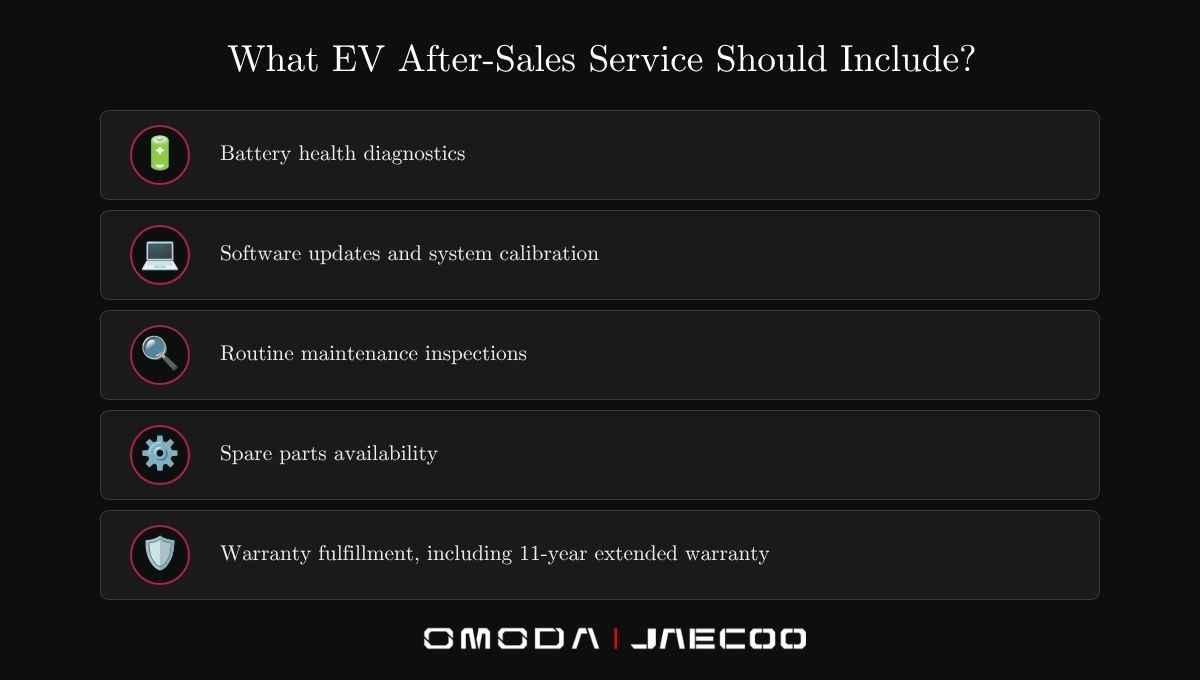
The components of a proper after-sales program for EV's should include; battery health diagnostics, software updates, routine inspection, parts availability, warranty support, and charging guidance.
These are not added on items. They are the core of responsible EV ownership.
The most costly item in any EV is the battery. Capacity can change over time due to charge cycles, temperature extremes, and terrain stress.
Authorized service centers perform deep diagnostics for cell balancing, thermal performance, and remaining capacity.
All the battery diagnostics at Omoda Jaecoo Nepal are done by certified Technicians with manufacturer approved tools and not generic tools. This is particularly relevant for those who own their business in regions where there is enormous temperature difference, for instance from the Terai to the higher elevations.
All modern EVs, such as the Omoda E5 and Jaecoo J5, are programmed and calibrated over the air to deliver the best performance for their motors, ADAS sensors, and range prediction.
These cannot be done at a general workshop. Failure to install software updates can diminish the performance of vehicle's safety systems (19+ ADAS) which are particularly aimed at helping on the often-dangerous roads of Nepal.
There is no oil change, no timing belt, no fuel filter; EV's need much less routine maintenance. The annual maintenance cost of an EV in Nepal is estimated to be between NPR 15,000 and 25,000, whereas that of an equivalent fuel vehicle is NPR 1,20,000 – 1,60,000.
In that routine checkup, though, the same checkup is conducted for several things, including the brake fluid, thermal management coolant, tire condition, suspension, HVAC systems and brake pad wear, all important for Nepal's terrain.
This is where many smaller or newer EV distributors are lacking. Electric vehicle spare parts can only be used as specified and must not be replaced with other generic parts.
Omoda Jaecoo Nepal keeps its parts stocked with the manufacturer and provides service to its customers not just in the Kathmandu showroom but all over Nepal.
For Dharan or Chitwan residents, it is more than likely you can obtain whatever you need without having to wait months for a shipment.
One of the top ownership assurances in Nepal's EV market is provided by Omoda Jaecoo Nepal with 11-year extended warranty. However, a warranty is only as meaningful as the distributor that backs up the guarantee. An authorized dealer guarantees the manufacturer's support for each and every claim.
Your warranty can be rendered useless if your service center either goes out of business or changes brands. This is a genuine threat in a competitive EV segment where a number of competitors enter the fray and then exit.
The EV market is taking off quickly in Nepal. The proportion of EVs in new vehicle sales is nearly 80%- 85% in 2026. That increased growth has also attracted dozens of brands with a finite number of customers, with many of those brands being represented by dealers that have narrow profit margins and limited product infrastructure.
Economics will play against them, and the customer will be the last to know and first to feel the pain. You may end up with a very costly car, no repair shop in the vicinity, and a no-good warranty.
That is why it is not only a good idea to buy from a financially stable, authorized dealer who has a solid long-term relationship with Nepal, but it's a smart move, as well.
Omoda Jaecoo Nepal is based in Kathmandu, and operates with locally made decisions, catering to the buyers of Pokhara to Biratnagar. The brand is not Nepal-centric, it's a business brand. The aim is to create a long-term EV ownership journey experience, not just the sale.
Many would assume that sales support stops when they reach the workshop, but charging guidance is a part of the car ownership journey. Charging support is another important part of EV after-sales service in Nepal
We have established a progressively expanding network of EV charging stations with stations along major highways and checkpoints around every 60 km at OMODA & JAECOO Nepal, which makes long-distance travel more convenient. The battery charging time ranges from 30-80% in approximately 3-4 hours when plugged in via AC power and 40-45 minutes when plugged in via a DC fast charger. There is also a home charger to make it easy to charge your EV at home or on the road. It makes a world of difference for the owners of Nepal. A map of where the chargers are located, a prompt response to help, and instructions on how to charge at home will help eliminate range anxiety and ease EV usage in everyday driving.
Make sure to ask some simple, but important questions before purchasing an EV SUVs in Nepal. Is there a trained service team or is it a regular garage?
Does the brand provide a direct supply of spare parts? What is covered by the warranty? Do you have roadside assistance?
Will the brand be able to survive for the customers outside of Kathmandu?
In this view, it is possible to distinguish between short-term selling and long-term ownership support by the following questions.
Here's a quick list of things to check:
|
Question |
Why it matters |
|
Is your service team a trained service team or a general garage? |
Installing high-voltage systems in EVs is a certified handling. |
|
Do you get your spare parts directly from the manufacturer? |
Safety and warranty support can be impacted by generic parts. |
|
What does your warranty really mean and who is following it? |
There are some warranties that rely on the dealer and are not based on the brand. |
|
How do you support buyers outside Kathmandu? |
Most of the country in Nepal is not in the valley. |
|
What do you offer as a post-sale support for charging? |
Range anxiety is a support problem, not just a range problem |
|
Do you have roadside assistance? |
Essential on mountain roads and off-road routes. |
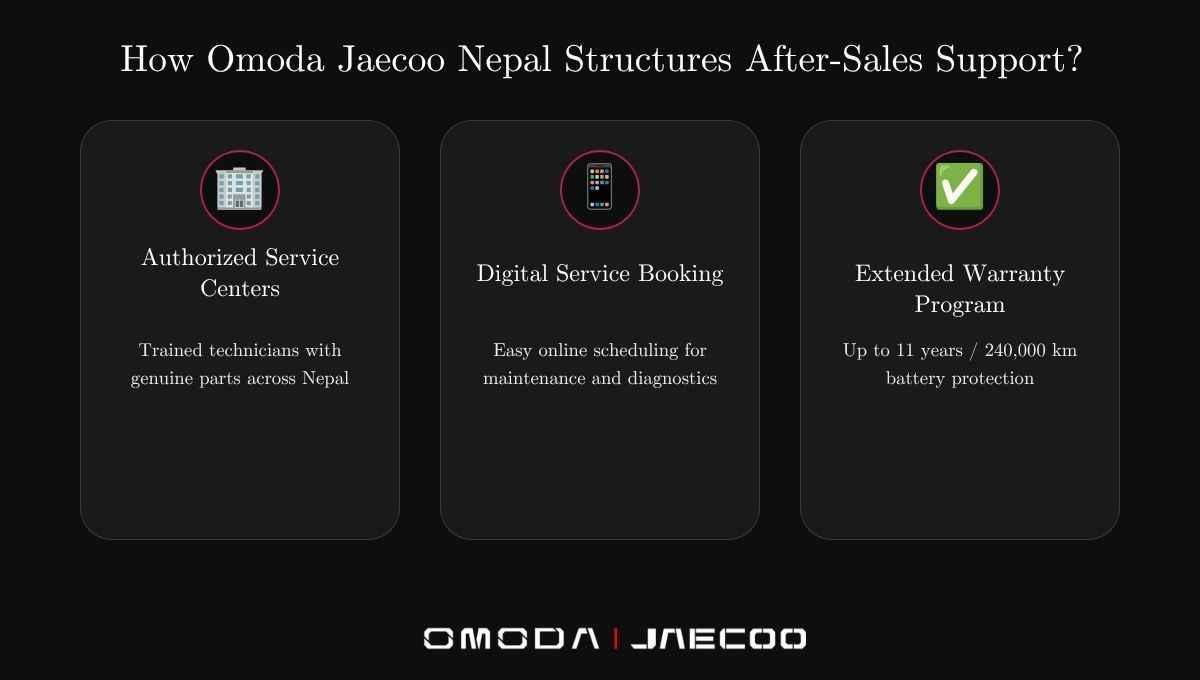
Once you've purchased a house, the ownership journey continues like this:
Before buying: You can check the entire vehicle range and pricing, ask questions at the phone number 980-1143672 or visit the showroom at Palace, Uttardhoka Behind, Kathmandu 44600.
At purchase: Finance options, registration support, and EV incentive from the government are provided.
After purchasing: The authorized service team performs battery diagnostics, software updates, periodic check-ups, warranty claims, and instructions on charging networks.
Ongoing: 11 years extended warranty ensures that Omoda Jaecoo Nepal is committed to your vehicle for more than the next sales target.
The physical showroom is in Kathmandu. That's a true fact. Omoda Jaecoo Nepal caters to buyers from all over the country, Pokhara, Butwal, Biratnagar, Dharan and elsewhere.
The entire research and pre-purchase process can take place online and over the phone, if you can't go in-person. Test drive bookings, price enquiries, and service queries can be made without being in Kathmandu. The service network is also being established to minimize the need for long-distance travel for routine service.
EV after-sales service is one of the most important parts of EV ownership in Nepal.
It protects the battery, keeps the software current, supports charging, reduces downtime, and gives owners confidence that help will be available when they need it.
The best EV for buyers is not necessarily the one that has the most desirable features when it is bought. It is the one with a service network that remains with you in the long-term.
Don't select an EV based solely on its road-going capabilities. At the start of the road ask, "who will be there to help her after I start? So, make sure to Explore OMODA & JAECOO EVs.
We suggest a service after every 12 months or 10,000 kms.
Yes. We do provide roadside assistance if necessary.
Yes. Genuine spare parts are available at authorized service centers in Omoda Jaecoo.
Extended warranty program covers battery coverage extended to 11 years, or 240,000 km (whichever occurs first) and drive motor coverage extended to 11 years or 200,000 km (whichever occurs first) under the terms and conditions stated.
Yes. Our charging station is located approximately every 60 km along the main highways and checkpoints; both fast charging and standard charging will be provided.
How Much Does It Cost to Charge an Omoda or Jaecoo EV in Nepal?
August 12, 2026
How Much Does It Cost to Charge an Omoda or Jaecoo EV in Nepal?
August 12, 2026
Key Takeaways
· Charging an Omoda or Jaecoo EV in Nepal typically costs Rs. 406–723 at home.
· NEA public charging remains one of the most affordable public charging options.
· Private DC fast charging costs more but provides rapid charging for long-distance travel.
· The Omoda E5 Pro currently has the lowest full-charge cost in the lineup.
· LFP battery technology offers enhanced safety and long-term durability.
· EV running costs remain substantially lower than comparable petrol vehicles.
The answer is one of the biggest reasons why EV adoption is rapidly expanding in Nepal.
While petrol prices continue to fluctuate and currently sit around Rs. 200 per litre (current rate). Electricity is still one of the lowest cost options for vehicle powering at Petrol or diesel.
From home charging to Nepal Electricity Authority (NEA) charging stations, to DC fast charging on road trips, EV operation is much more cost-effective than petrol-powered SUVs of similar size.
The cost savings are even more compelling for Omoda and Jaecoo owners. As long-range battery technology, expanding charging infrastructure, reduced maintenance expenses and government incentives for electric mobility all become part of the equation.
This guide will tell you how much you may see charging an Omoda or Jaecoo EV in Nepal cost, how much it costs to charge at home and how much it will cost to charge at public charging stations, and how much it will cost to charge each of the Omoda E5 Pro, the Jaecoo J5 and the Jaecoo J6T.
In addition, we will discuss the estimates of cost per kilometer, monthly running charges, types of EV charging stations in Nepal, battery technology and warranty period, and frequently asked questions by Nepali EV buyers.
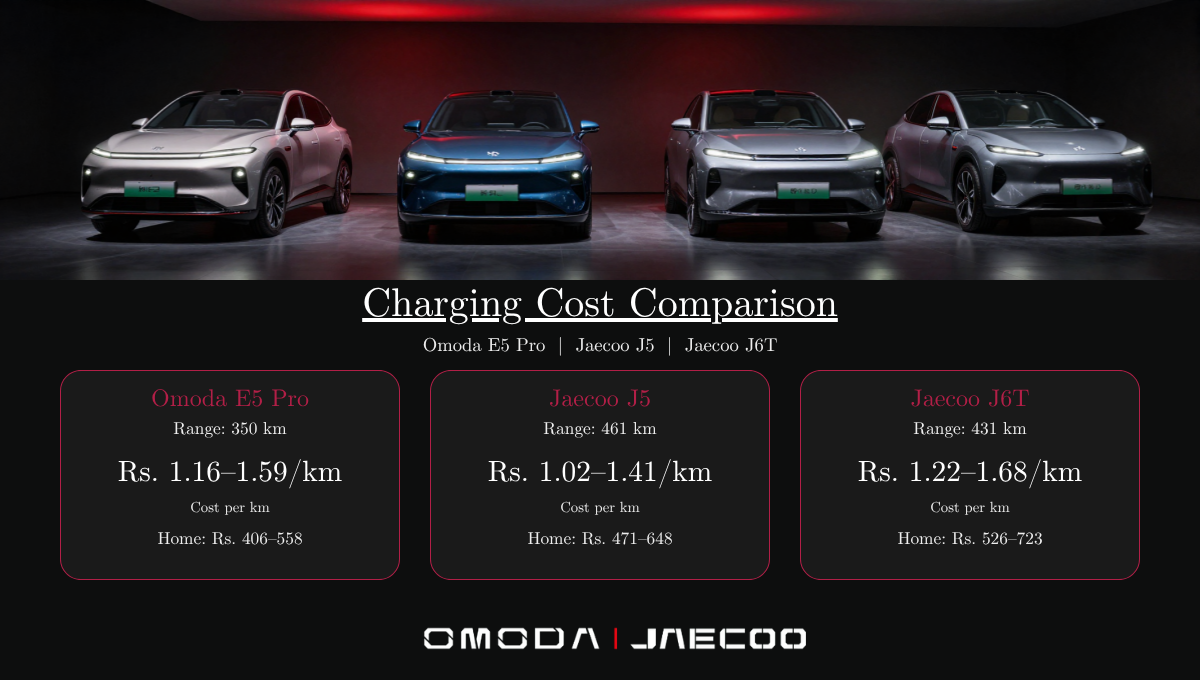
At current charging tariffs and electricity costs, a full charge will approximately cost:
|
Charging Method |
Estimated Cost |
|
Home Charging |
Rs. 400 – Rs. 723 |
|
NEA Public Charging |
Rs. 304 – Rs. 690 |
|
Private DC Fast Charging |
Rs. 761 – Rs. 1,314 |
Disclaimer: Charging costs are estimated and may vary based on the latest electricity tariff. Please check current electricity rates before calculating your charging cost.
The exact cost depends on:
· Battery size
· Electricity tariff
· Charging location
· Charging time
· Household electricity consumption
Most car owners will find that home charging is still the cheapest alternative.
A battery size determines how much it will cost to charge an EV.
The following are the latest battery specifications of Omoda and Jaecoo EVs available in Nepal.
|
Model |
Battery Capacity |
Driving Range |
|
Omoda E5 Pro |
50.7 kWh |
Up to 350 km (WLTP) |
|
Jaecoo J5 EV |
58.9 kWh |
Up to 461 km |
|
Jaecoo J6T EV |
65.69 kWh |
Up to 431 km |
The bigger the battery, the more energy it can hold, and the greater the range it can provide, but the larger the battery, the more fully it can be charged and the higher the cost.
Charging Cost = Battery Capacity (kWh) × Electricity Rate (per kWh).
Example:
Omoda E5 Pro
50.7 kWh × Rs. 10 = Rs. 507
This calculation assumes that the battery is charged from 0% to 100%.
For the majority of EV owners, charging from empty is a rare occurrence. As for real world charging, daily charging is usually between 20% to 80% with actual charges much lower.
Some of the most common errors in EV articles are assuming that everyone pays the same electricity rate.
Nepal Electricity Authority (NEA) has progressive slab pricing, that is, the price of electricity changes based on the total monthly consumption of electricity by a house.
If the amount of electricity used grows, more units could become subject to higher tariff bands.
This means that the total cost of home charging will vary depending on the EV and the monthly electricity consumption of your home.
There is a misconception that NEA is responsible for hike in electricity tariffs.
The rates of electricity tariffs do not change.
To address the situation, the Government of Nepal implemented a 5% value added tax (VAT) on residential electricity bills for consumers whose consumption exceeds 50 units per month.
Those savings will be a minor amount of the cost of owning an EV, as most EV-owning households will likely exceed that limit on their bills.
Not all charging stations are the same.
By knowing the various charging options available, you can determine which one will best suit your lifestyle and budget.
This is the most common charging practice for EV owners in Nepal.
You can charge your car at home, using a standard 220V electrical outlet in the home.
Typical Characteristics
· Standard household outlet
· Convenient overnight charging
· Adds approximately 6–10 km of range per hour
· Lowest charging cost
Most homeowners effectively pay around:
Rs. 8–12 per kWh
A full charge for a 40-kWh EV battery may cost approximately:
Rs. 320–480
For most drivers, home charging provides the best combination of convenience and affordability.
A dedicated 7 kW wallbox charger is a popular choice for EV owners.
Benefits include:
· Faster charging speeds
· Improved safety
· Better charging efficiency
· Greater convenience
The average installation price is between:
Rs. 30,000–60,000
Depending on wiring requirements, and the layout of the property.
Explore our complete EV charging guide.
These chargers are found more frequently at:
· Shopping malls
· Hotels
· Commercial complexes
· EV dealerships
· Public parking facilities
The normal power output is in the range of:
7 kW and 22 kW
Most EVs can be fully charged in about:
4–8 hours
NEA stations normally levy utility fees, which are dependent upon time of day, below transportation tariffs.
Rates are typically:
· Off-peak: around Rs. 6/kWh
· Daytime: around Rs. 9/kWh
· Peak periods: around Rs. 11/kWh
Private operators may charge:
Rs. 12–18 per kWh
for the convenience of premium locations.
DC fast chargers are built to handle fast charging, especially for long-distance trips.
DC chargers send electricity straight to the battery, as opposed to the AC charger, which is in the car.
· 50 kW
· 60 kW
· 120 kW
· 150 kW+
Most modern EVs can be charged from:
20% to 80% in approximately 30–60 minutes
This varies according to the charger's power and battery specifications.
Private DC fast charging typically costs:
Rs. 15–20 per kWh
A complete charge for a 50-kWh battery generally costs:
Rs. 750–1,000
This is a lot easier and cheaper than filling up a petrol car for a comparable range.
The Omoda E5 Pro is an efficient, intelligent, and practical model to use for everyday driving.
Key Specifications
· 50.7 kWh Battery
· LFP Battery Technology
· Up to 350 km WLTP Range
· 110 kW DC Fast Charging
|
Charging Type |
Cost |
|
Home Charging |
Rs. 406 – Rs. 558 |
|
NEA Public Charging |
Rs. 304 – Rs. 533 |
|
Private DC Fast Charging |
Rs. 761 – Rs. 1,014 |
Approximately:
Rs. 1.16–1.59 per km
The Jaecoo J5 offers a great deal of performance, range and charging affordability.
Key Specifications
· 58.9 kWh Battery
· Up to 461 km Range
· Advanced Battery Management System
|
Charging Type |
Cost |
|
Home Charging |
Rs. 471 – Rs. 648 |
|
NEA Public Charging |
Rs. 353 – Rs. 618 |
|
Private DC Fast Charging |
Rs. 884 – Rs. 1,178 |
Approximately:
Rs. 1.02–1.41 per km
Learn more about the Omoda E5 Pro specifications.
The Jaecoo J6T is built for drivers seeking long-distance confidence and premium SUV capability.
Key Specifications
· 65.69 kWh Battery
· Up to 431 km Range
· 130 kW DC Fast Charging
|
Charging Type |
Cost |
|
Home Charging |
Rs. 526 – Rs. 723 |
|
NEA Public Charging |
Rs. 394 – Rs. 690 |
|
Private DC Fast Charging |
Rs. 985 – Rs. 1,314 |
Approximately:
Rs. 1.22–1.68 per km
If you assume you drive about 1,000km per month, estimated charging costs are:
|
Model |
Monthly Charging Cost |
|
Omoda E5 Pro |
Rs. 1,160–1,590 |
|
Jaecoo J5 |
Rs. 1,020–1,410 |
|
Jaecoo J6T |
Rs. 1,220–1,680 |
These numbers can fluctuate depending on driving habits, topography, weather and charging patterns.
There are other elements of the EV ownership equation besides charging cost.
The battery chemistry is a significant factor in:
· Safety
· Durability
· Charging performance
· Thermal stability
· Long-term ownership costs
The Omoda E5 Pro is powered by Lithium Iron Phosphate (LFP) battery.
Advantages include:
· Exceptional thermal stability
· Enhanced safety
· Long cycle life
· Reduced degradation
· Better tolerance for frequent charging
LFP batteries are one of the safest EV batteries available now.
Modern Omoda and Jaecoo EVs continuously monitor:
· Temperature
· Charging speed
· Voltage
· Cell health
This intelligent battery management helps optimize performance and maintain long-term battery health.
Charging costs are just one part of the EV ownership consideration! They may be the most critical parts of a vehicle, and that is where long-term confidence is gained.
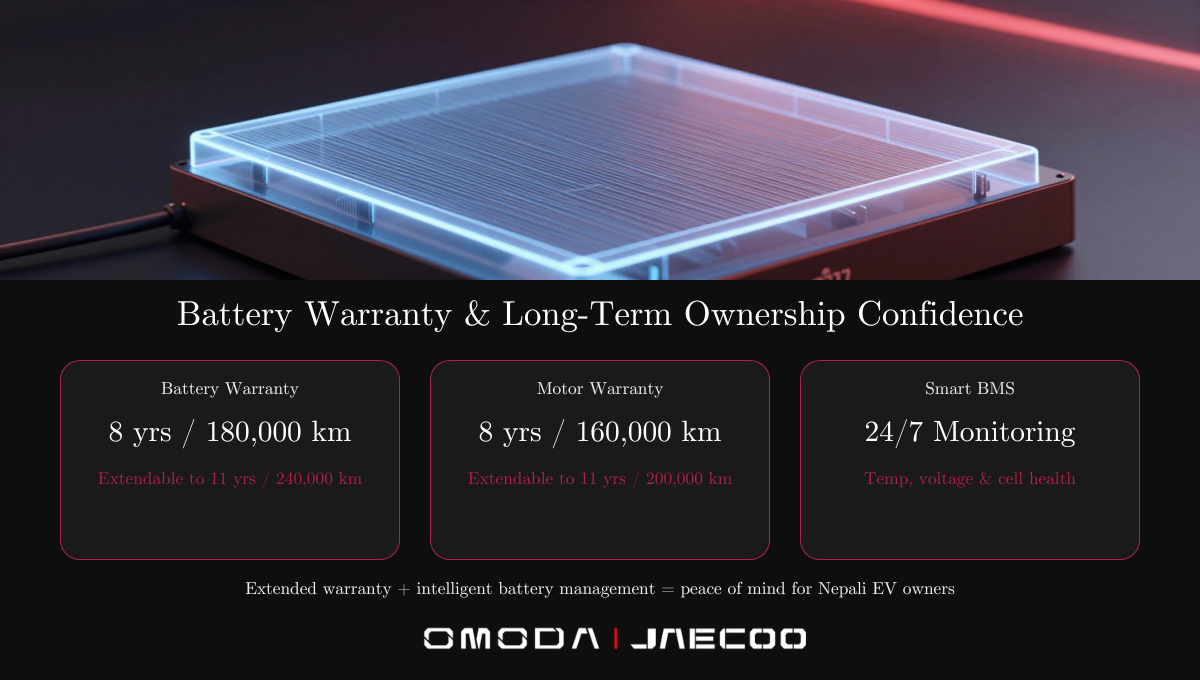
All Omoda and Jaecoo EV have a manufacturer-backed warranty with a high-voltage battery of 8 years or 180,000 km and electric motor of 8 years or 160,000 km. To enjoy utmost peace of mind, eligible vehicles are eligible for Omoda Jaecoo Nepal's Extended Warranty Program that extends the warranty by an additional 3 years or 60,000 km. This means that the total battery protection is extended to 11 years or 240,000 km; the total motor protection is extended to 11 years or ,000 km.
Advanced Battery Management Systems (BMS) provide battery temperature, voltage, charging performance and battery condition monitoring, and full warranty coverage. These smart systems allow for optimized efficiency, ensure long-term durability, and deliver reliable performance throughout the vehicle's life.
This combination of extended warranty, intelligent battery monitoring, and authorized after-sales service promises a more secure ownership journey, more resale value, and confidence to EV owners in Nepal.
The government of Nepal has made a strong commitment to promoting electric mobility by investing in charging stations and implementing supportive policies.
NEA has been consistently rolling out public charging stations in Nepal.
Recent developments include:
· The seven provinces will have charging stations.
· High speed corridors between major cities.
· Multi-vehicle charging facilities
· Online charging management systems that are integrated.
These investments are paving the way for longer-range EV travel.
Nepal is promoting EV adoption through:
· Reduce tax on EV imports
· The demand for imported fuel is lowered.
· Encourage the growth of charging infrastructure
· Improved access to EV financing
These efforts are contributing to increasing the accessibility of EV ownership for consumers in Nepal.
At the current price of petrol, which is around Rs. The long-term economics are now increasingly favorable for EVs, with pricing at NPR 200 per litre.
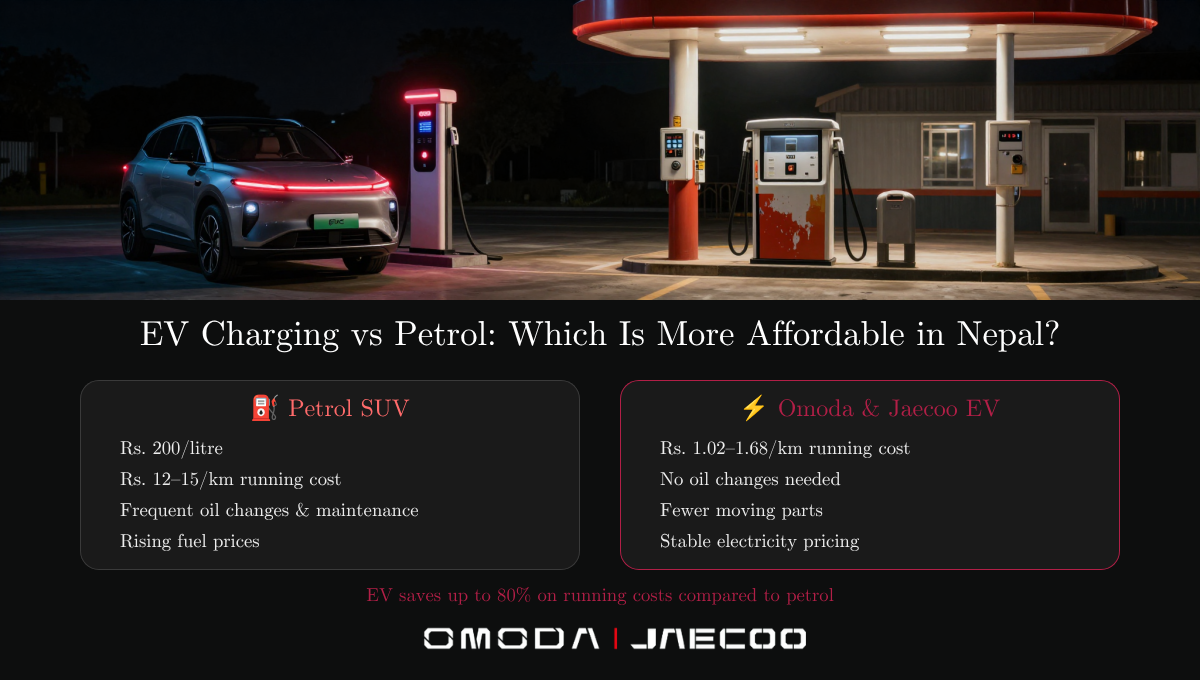
Disclaimer: Petrol costs are estimated and may vary based on the latest fuel prices. Please check current petrol rates before calculating your fuel cost.
EV owners will receive benefits including:
· Lower energy costs
· Reduced maintenance expenses
· No oil change requirements.
· Fewer moving components
· Forecasted monthly running expenses
With low prices to charge and growing infrastructure, EV ownership is an attractive long-term investment.
So, if you are wondering how much it costs to charge an Omoda or Jaecoo EV in Nepal, then it is very simple.
The amount of charge to run a full charge is:
· Rs. 406–723 at home
· Rs. 304–690 at NEA public charging stations
· Rs. 761–1,314 at private DC fast chargers
The actual cost depends on the size of the battery, electricity usage, charging frequency, and charging location.
One thing is certain, though, however it is far cheap to charge an Omoda or Jaecoo EV as compared to fueling a similar petrol vehicle. With superior battery technology, expanding charging network, and lower operating expenses, the ownership of EVs remains one of the most astute mobility decisions for Nepali drivers.
Drive an Omoda and Jaecoo EV to experience the performance, technology and savings.
Find out the smarter way to drive on a test drive today!
A full charge typically costs between Rs. 406–723 at home, Rs. 304–690 at NEA public charging stations, and Rs. 761–1,314 private DC fast chargers, depending on the model.
Yes. The most cost-effective method is usually home charging, which is the cheapest per unit of electricity and the best way to charge a day.
NEA-operated public charging stations usually have lower rates during non-rush hours, typically 10 pm to 5 am.
A dedicated wall box charger installation typically costs between Rs. 30,000 and Rs. 60,000, depending on the electrical set-up of the property, 60,000.
The Omoda E5 Pro is powered by a Lithium Iron Phosphate (LFP) battery, which is safe, long-lasting, and durable.
Yes. Considering the cost of electricity, the running and maintenance expenses of EVs are much lower than those of similar petrol-based cars.