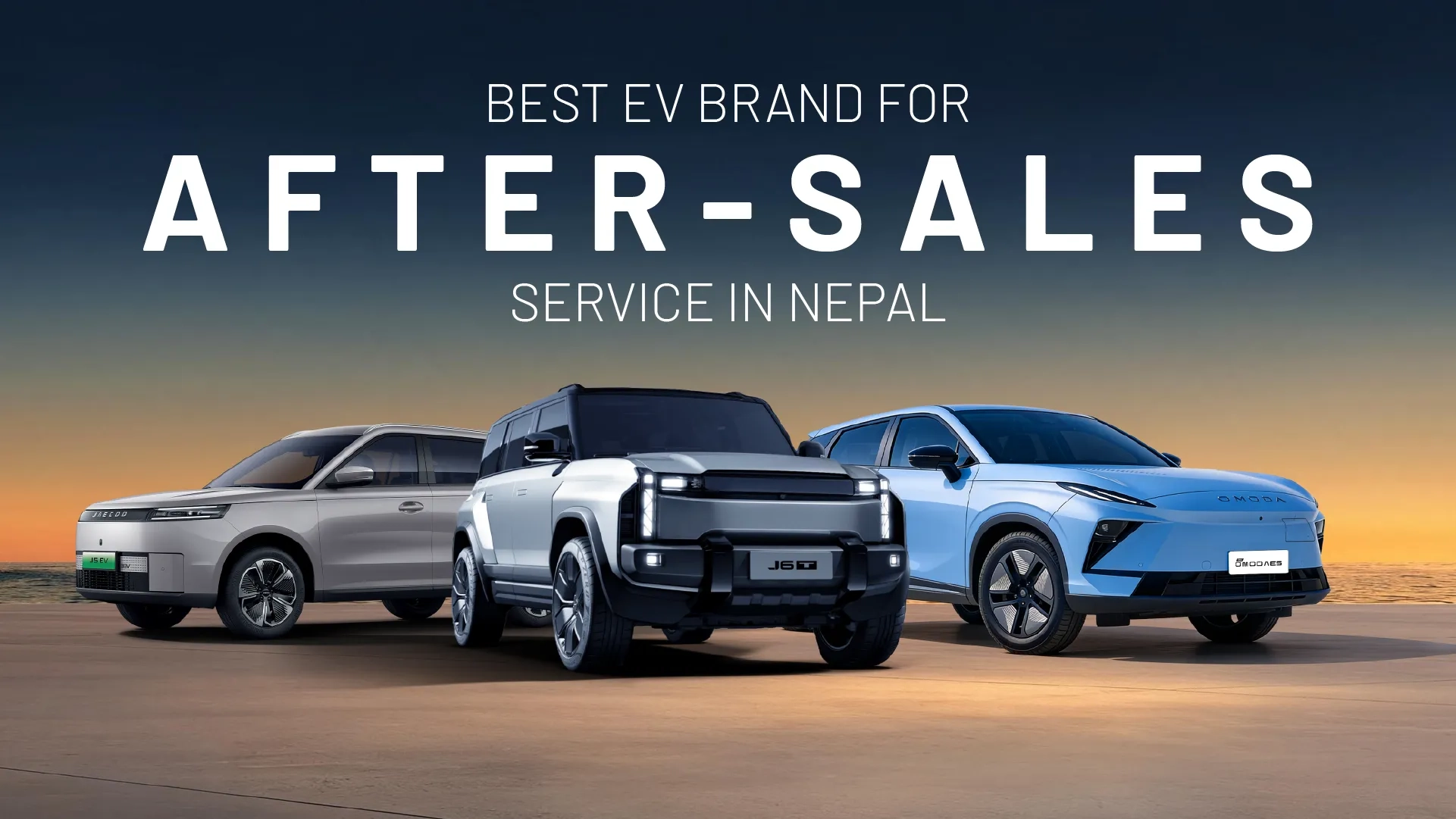
Best EV Brand for After-Sales Service in Nepal
October 12, 2026
Best EV Brand for After-Sales Service in Nepal
October 12, 2026
When buying an EV in Nepal, most comparisons start with price, range, battery capacity and features.
However, a question arises after the car is bought: Who will take care of your vehicle when you need it?
After sales service is not just having a showroom close by for an EV owner.
It offers authorized workshops, trained technicians, battery diagnostics, genuine spare parts, warranty, and roadside assistance. It also implies knowing what to do if you are away from Kathmandu or have encountered a problem on a long-distance trip.
Key Takeaways
The after-sales service is as important as the price and range. Look into the service network, service warranty, spare parts, technicians, diagnostics, roadside assistance, and maintenance expenses.
Network size isn't the only factor. Accessibility where you live and travel is more important than the service reach offered by BYD or Tata.
Read the warranty conditions carefully. Compare the coverage, limits of time and distance, exclusions, servicing requirements, and claims.
OMODA & JAECOO has a multi-city service coverage and provides genuine spare parts, EV diagnostics, roadside assistance and structured battery & motor warranty programme.
There is no one size fits all for an EV. Prior to purchase, inquire about service, warranty procedures, availability of parts, and scheduled maintenance costs.
A strong EV after-sales programme should answer a few practical questions: Can you reach an authorized workshop easily? Can the workshop diagnose EV-specific faults? Are genuine parts available? What happens if the battery or motor develops a problem? And who helps if the vehicle stops outside your home city?
That provides a greater framework for buyers than just to ask, "which brand has the most dealerships?
|
What to compare |
Why it matters |
|
Service network |
Determines how easily you can access authorized support |
|
Battery and motor warranty |
Protects against uncertainty around major EV components |
|
Spare parts |
Can affect repair time and vehicle downtime |
|
Technicians |
Specialist electrical and high-voltage expertise is needed for EVs |
|
Diagnostics |
Helps identify battery, motor and electronic faults |
|
Roadside assistance |
Matters when problems occur away from home |
|
Maintenance cost |
Helps estimate long-term ownership expenses |
A large network is nice, but location is more important to an individual owner.
The nearby workshop might be the priority for a Kathmandu commuter.
If you have a frequent requirement to go to Pokhara, Butwal, Chitwan or eastern Nepal, regional service coverage and roadside assistance is a more critical issue.
Before buying, ask:
Where is the nearest EV authorized service centre and how can I be supported on my daily commuter routes?
Currently, OMODA & JAECOO have service locations in Biratnagar, Biratnagar, Biratnagar, Birtamode, Butwal, Dang, Dhangadhi, Itahari, Nepalgunj, Pokhara, Sitapaila and Surkhet; we cover the entire major cities of Nepal.
You can check the latest locations through our OMODA & JAECOO service network.
When assessing long-term EV ownership, some of the key components to consider are the battery and the electric motor.
However, a warranty headline doesn't say everything.
Before buying, check:
Warranty duration
Kilometre limit
Covered components
Exclusions
Servicing requirements
Approved-parts requirements
Claim procedure
Insurance conditions
OMODA & JAECOO's standard manufacturer warranty covers the traction battery for 8 years/180,000 km and the drive motor for 8 years/160,000 km, whichever comes first.
The extended programme also provides for a battery coverage of 11 years / 240,000 km and a drive motor coverage of 11 years / 200,000 km (based on programme terms).
The extended warranty is offered for eligible models and under certain terms. So buyers need to read the terms and conditions, and not assume that the 11 year cover is unlimited.
The overarching lesson is for all EV brands: don't just look at how long the warranty is; look at what it covers.
Even if the required technician is available, a workshop may not have the necessary component to finish a repair quickly.
Therefore, it is important for buyers to ask:
Do you have genuine spares available in the country?
What are the normal components of the routine?
How are less-common components supplied?
How long is the average waiting time?
Do parts come from an authorized distributor?
At OMODA & JAECOO, the original spare parts can be obtained from its authorized service centers throughout Nepal.
A good rule of thumb is to first visit the service center and inquire about what commonly used parts are available.
That will provide you with a more realistic idea of downtime than a general comment on parts of availability.
An EV is not just a car without a petrol engine.
Technicians might have to perform a diagnostic test on the traction battery, battery management system, electric motor, charging system, cooling system, and high voltage electrical system.
It's important to have EV-specific tech skills and diagnostics as part of the after-sales service.
It is important to ask any dealer the following question:
“If my EV comes with a warning on its battery or high voltage system, will this workshop be able to diagnose this problem here?”
The answer can tell you more about a service center's capability than its size.
The published service information outlines the authorized service support and EV diagnostics included in the ownership programme for OMODA & JAECOO owners.
You can also read our EV after-sales service guide for Nepal for a closer look at what owners should expect.
Roadside assistance can be especially useful if you frequently travel to other cities.
Having a vehicle stop on your driveway is not convenient. When a vehicle has a problem on the Kathmandu–Pokhara road or during any other trip on a highway, it poses a different challenge.
Before purchasing, confirm:
Whether assistance operates 24/7
Whether towing is included (Yes/No)
Where assistance is available
How to request support
What do you do if the car won't start
OMODA & JAECOO's current service information confirms that EV roadside assistance is provided in Nepal.
For the latest contact information, owners should use the current official service page and vehicle documentation rather than relying on older numbers shared elsewhere.
One common misconception is that an EV is maintenance-free.
It is not.
EVs eliminate some conventional engine-related maintenance, but owners still need to consider battery health, cooling systems, electrical connections, tyres, brakes, suspension and other vehicle systems.
OMODA & JAECOO recommends servicing every 10,000 km or 12 months, whichever comes first.
Published maintenance estimates include NPR 5,000–10,000 for battery maintenance, NPR 3,000–7,000 for cooling-system maintenance, and NPR 2,000–5,000 for motor inspection.
Together, these categories represent an estimated NPR 10,000–22,000 per year.
These are "planning" estimates and not guaranteed annual bills.
For the detailed breakdown, see our OMODA & JAECOO ownership and service cost guide.
It depends on your EV use.
|
Your situation |
What to prioritize |
|
Mainly drive in Kathmandu |
Use nearby workshop and diagnostics |
|
Frequently travel between cities |
Regional coverage and roadside assistance. |
|
Live outside Kathmandu |
A variety of local services and parts availability. |
|
Plan long-term ownership |
Battery/motor warranty and parts support |
|
Drive high annual kilometres |
Warranty of kilometre limits and service intervals. |
|
First-time EV owner |
Clear warranty and technician support |
Hence the question "Which is the best EV brand for after sales service in Nepal?" doesn't have one uniform answer!
The more pertinent question is:
What's my driving style, and which brand support system is it?
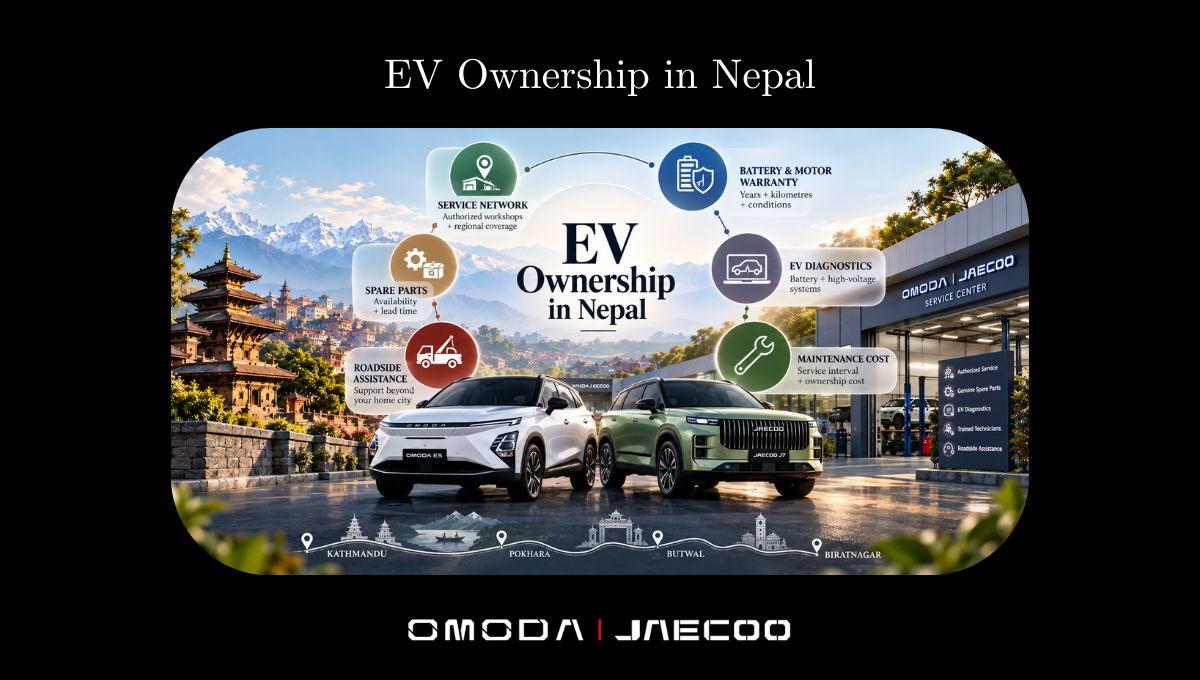
Our current service network extends across major locations in Nepal, including Kathmandu-area locations, Pokhara, Butwal, Biratnagar, Nepalgunj, Dhangadhi, Itahari, Narayanghat and Surkhet.
It's backed by authorized servicing, availability of genuine spares, EV roadside assistance, and structured battery and motor warranty programmes.
You can also find the latest prices of available OMODA and JAECOO models on our current official OMODA & JAECOO Nepal price page, so that you can confirm the current prices before booking.
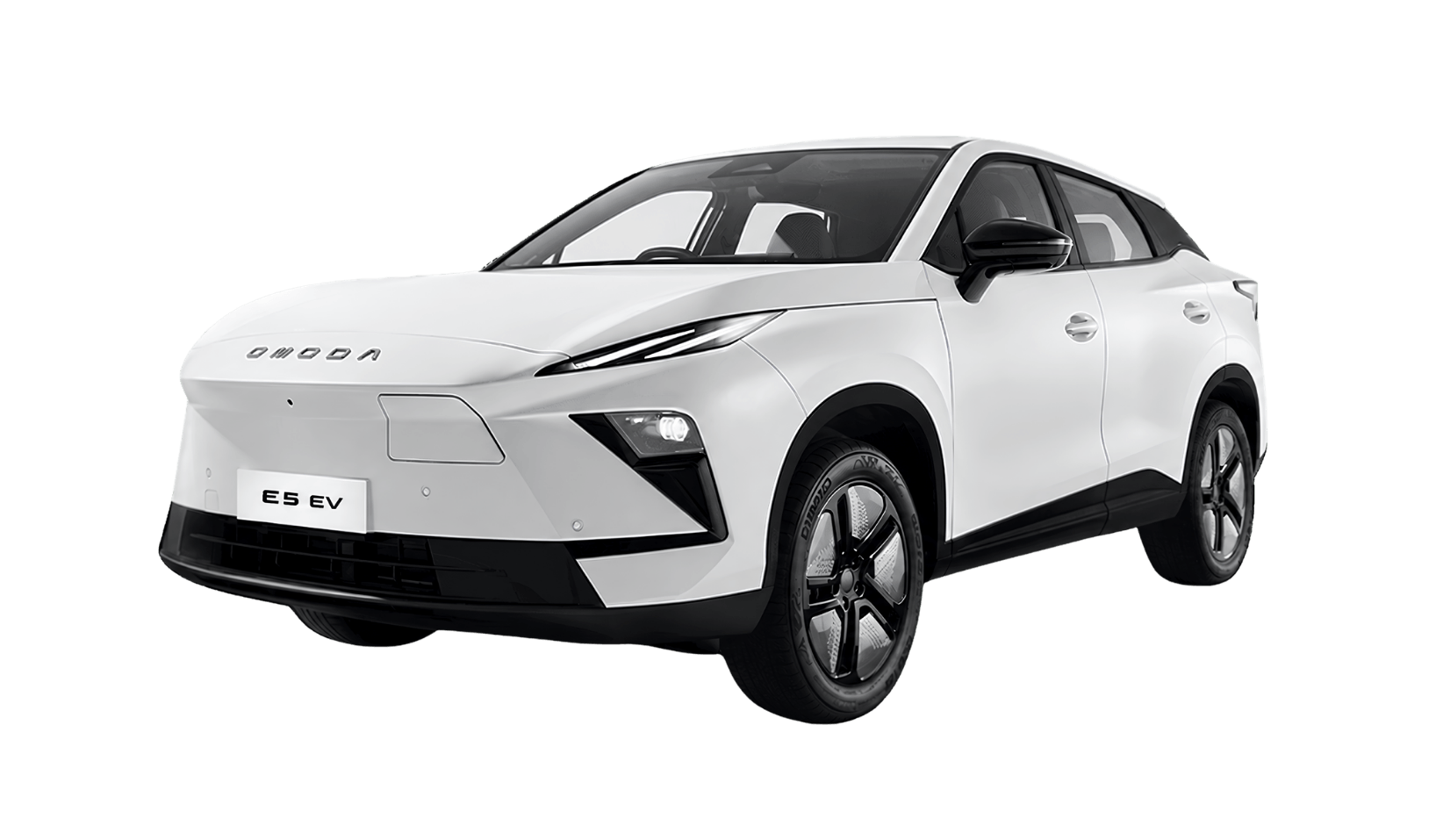
If you are looking to compare electric SUVs, our OMODA E5 Pro and JAECOO J5 comparison offers a more in-depth comparison at the model level.
It's important to understand that not all buyers would require the same model or service package. It is that a vehicle's after-sales service should be assessed with the vehicle.
|
Factor |
Current OMODA & JAECOO support |
|
Service interval |
10,000 km or 12 months |
|
Standard battery warranty |
8 years/180,000 km |
|
Standard motor warranty |
8 years/160,000 km |
|
Extended battery coverage |
Up to 11 years/240,000 km |
|
Extended motor coverage |
Up to 11 years/200,000 km |
|
Service coverage |
Major locations across Nepal |
|
Genuine spare parts |
Available through authorized service centers |
|
EV diagnostics |
Made available via authorized service support |
|
Roadside assistance |
Available |
|
Published maintenance estimate |
NPR 10,000–22,000/year |
The extended warranty comes with applicable eligibility, servicing, documentation, and programme conditions.
Before signing a booking form, ask the dealer:
Where the answers are not obvious, it may be worthwhile to clarify those answers before purchasing.
Rather than compare a brand's ranking, compare each EV with the other EVs on the same basis:
|
Criteria |
What to verify |
|
Service network |
Nearest authorized workshop |
|
Geographic coverage |
Support in your home and travel areas |
|
Battery warranty |
Years, kilometers and exclusions |
|
Motor warranty |
Coverage and mileage |
|
Spare parts |
Local availability and lead time |
|
Diagnostics |
Battery and high voltage capacity |
|
Technicians |
EV-specific training |
|
Roadside assistance |
Breakdown and towing assistance |
|
Maintenance |
Service interval and cost estimate |
|
Warranty claims |
Process and documentation |
The best EV after-sales service in Nepal depends on the brand’s service network, warranty coverage, spare-parts availability, battery and motor support, and roadside assistance. Before buying, consider how easily you can access authorized service centers and support in your area.
Review the warranty terms and mileage, covered components, exemptions, service conditions, accepted parts, claims process and insurance conditions.
This is especially crucial for buyers outside Kathmandu as well as for those who do a lot of traveling between cities. Easily accessible authorized service can help minimize travel, downtime and stress of using specialists for EV services.
Availability is dependent on brand and component. Inquire with the distributor about what genuine parts are available at their local stock and about the usual delivery time of less commonly available parts.
The recommended service interval is 10,000 km or 12 months, whichever comes first.
Choosing an EV in Nepal is about more than range, features and showroom price. After sales service is part of ownership experience.
Check out the service network around your home and service routes before purchasing. Check the battery and motor warranty, spare parts availability, EV diagnostics, roadside assistance, and scheduled maintenance.
With a growing multi-city approach, Omoda & Jaecoo offers authorized service support, authentic spare parts, EV diagnostics, roadside assistance and structured battery and motor warranty coverage.
If you're looking for an electric SUV with an expanding service network and clear ownership support, then OMODA & JAECOO should be considered.
Visit our current models and prices, look into OMODA & JAECOO service network or get a feel of ownership experience at your local authorized center before you make a decision.
Because the right EV isn't just the one you enjoy driving today. It's the one you can confidently live with for years to come.